
When you're trading stablecoins on the Cronos blockchain, Ferro Protocol isn't just another decentralized exchange - it's a specialized tool built for one job: swapping assets that barely move in price. Think USDC to WCRO, LCRO to CRO, or any pair where the value stays close to $1. If that’s your goal, Ferro Protocol might save you money on slippage. But if you want to trade altcoins, use limit orders, or access deep liquidity, you’ll quickly hit walls.
What Ferro Protocol Actually Does
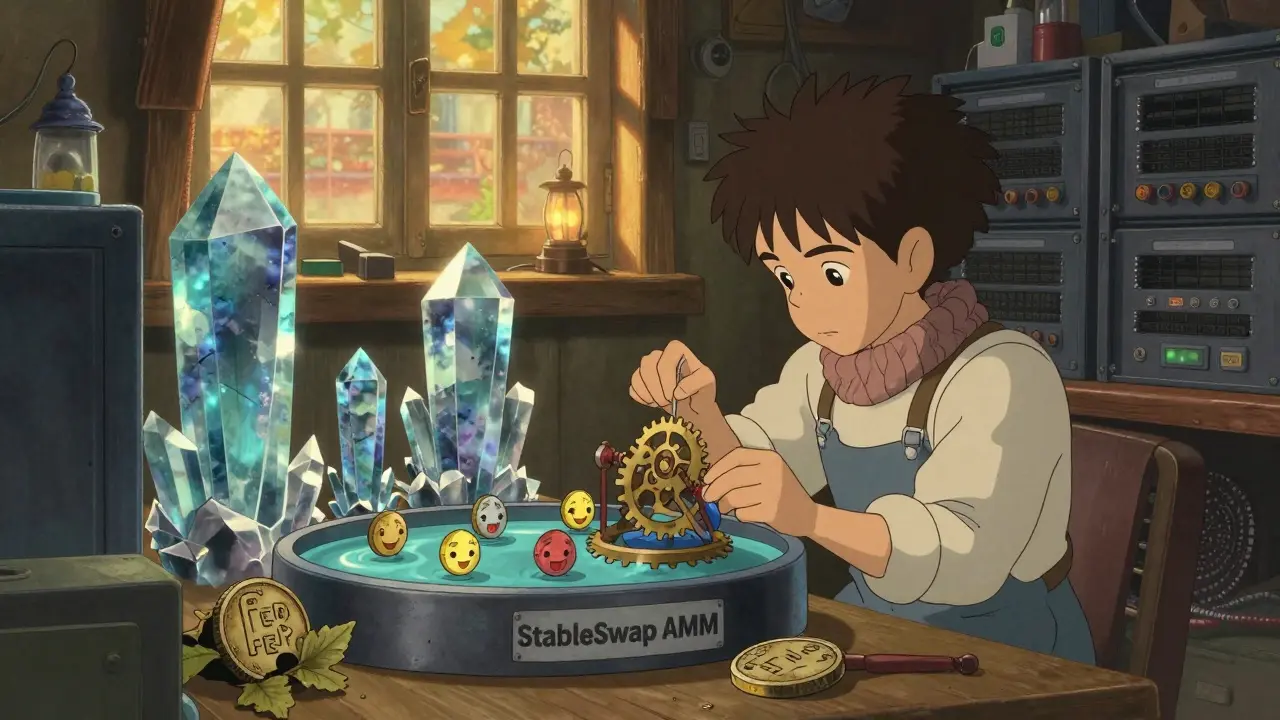
Ferro Protocol launched in July 2022 as a Ferro Protocol is a decentralized exchange (DEX) built exclusively on the Cronos blockchain. Unlike Uniswap or PancakeSwap, which handle hundreds of tokens with wildly different prices, Ferro uses a StableSwap AMM is a type of automated market maker optimized for assets with similar values algorithm. This means it’s engineered to keep trades between stablecoins and pegged tokens smooth, with almost no price slippage. That’s useful if you’re moving between USDC, WCRO, or LCRO - tokens that all aim to stay near $1.
There are only 5 coins listed and 8 trading pairs total. The most active pair is LCRO/WCRO, which makes up nearly half of Ferro’s daily volume. That tells you everything: this isn’t a place for Bitcoin or Solana trades. It’s a quiet corner of the Cronos ecosystem, built for users who need low-cost, low-slippage swaps between stable assets.
How It Works - And What You Need to Get Started
You can’t just connect your MetaMask and start trading. Ferro Protocol only works on the Cronos network. That means you need two things before you even open the site:
- CRO tokens are required to pay transaction fees on the Cronos blockchain - at least $2-3 worth, because failed transactions due to low CRO are the #1 issue users report.
- USDC or another supported stablecoin on the Cronos network - you can’t trade without it.
You’ll need a wallet that supports Cronos. Crypto.com DeFi Wallet and Trust Wallet are the most reliable. If you’re using MetaMask, you must manually add the Cronos network (chain ID: 25). Many users get stuck here - 32% of support queries in the Cronos Discord come from people with wrong network settings.
Once set up, trading is simple. You pick your pair, enter the amount, and confirm. No limit orders. No stop-losses. No margin. Just a direct swap. The interface is clean, which is why 6 out of 14 CoinGecko reviews mention "simple interface" as a plus.
Why It’s Not a Mainstream Exchange
Ferro Protocol’s biggest flaw isn’t bad code - it’s scale. As of October 2023, its 24-hour trading volume was just under $200,000. Compare that to Uniswap, which does over $200 million daily. Ferro handles 0.08% of Uniswap’s volume. On Cronos, it’s #12 out of dozens of DEXs. VVS Finance does over $23 million in daily volume. Ferro? Less than $100,000.
There are no API tools. No developer docs. No mobile app. No cross-chain support. If you’re trying to build something on top of Ferro, you’re out of luck. The protocol doesn’t even have a GitHub repository with recent activity - no commits in over a year.
And liquidity? Thin. Users report failed trades because there’s not enough depth in the pools. If you try to swap $500 of USDC for WCRO, you might get a price way off from what you expected. The solution? Trade smaller amounts - under $50 - and avoid peak times when liquidity drops further.
The FER Token: A Weak Incentive
Ferro’s native token, FER is the governance and utility token of Ferro Protocol, launched in July 2022 with a peak price of $0.126. Today, it trades around $0.0007. That’s a 99.4% drop from its high. Technical indicators are all bearish: RSI at 35, trading below both 50-day and 200-day moving averages. Prediction platforms like WalletInvestor and CoinCodex expect it to fall further, possibly below $0.0005 by late 2025.
There’s no staking, no yield farming, no rewards program tied to holding FER. It doesn’t reduce fees. It doesn’t give you voting power over protocol changes. It’s just there - a relic of the early days with no clear purpose now. If you’re holding FER, you’re holding a token with no utility and declining value.
Who Is This For? And Who Should Avoid It
Ferro Protocol has one real use case: users who already operate on Cronos and need to swap between stable assets with minimal slippage and low fees. If you’re moving USDC to WCRO to pay for a Cronos-based DeFi app, Ferro does it cleanly.
But if you’re looking for:
- A place to trade new altcoins - skip it.
- Deep liquidity for large trades - you’ll get slippage.
- Advanced features like limit orders or margin - it doesn’t exist.
- A growing ecosystem or active development team - there’s none.
The user base is small and experienced. According to a Twitter poll from August 2023, 78% of Ferro users had traded on at least three different blockchains. This isn’t a beginner-friendly platform. First-time users report spending 30-45 minutes just setting up their wallet and network.

Real User Feedback
On CoinGecko, Ferro has a 3.2/5 rating from 14 reviews. The top praise: "low transaction costs" and "simple interface." The top complaints: "extremely limited trading pairs," "low liquidity causing failed transactions," and "poor customer support."
On Reddit’s r/CronosChain, one user wrote: "Ferro works fine for USDC to WCRO swaps with almost zero slippage, but why only 8 pairs in two years?" That sums it up. It does one thing well, but hasn’t evolved.
There’s no Trustpilot page. No official support channel. The only community is the Cronos Discord server’s #ferro-protocol channel - with just 187 active members. That’s not a thriving ecosystem. That’s a ghost town.
The Bottom Line
Ferro Protocol isn’t broken. It works exactly as designed: a narrow, efficient tool for swapping stable assets on Cronos. If that’s your exact need, it’s worth trying. The slippage is low, the interface is clean, and the fees are minimal.
But if you’re looking for a real crypto exchange - one with volume, variety, or future potential - Ferro won’t deliver. It’s a niche tool in a shrinking corner of DeFi. With no updates in over a year, no new features, and a collapsing token, it feels more like a relic than a rising platform.
Use it if you have to. But don’t expect it to grow. Don’t invest in FER. And don’t assume it’ll be around in 2027. For now, it serves one small group of users well. Everyone else should look elsewhere.
Can I trade Bitcoin or Ethereum on Ferro Protocol?
No. Ferro Protocol only supports 5 tokens, all on the Cronos blockchain. These are mostly stablecoins like USDC and pegged assets like WCRO and LCRO. Bitcoin, Ethereum, Solana, and other major coins are not available.
Do I need to hold FER tokens to use Ferro Protocol?
No. You don’t need FER tokens to trade. You do need CRO tokens to pay for gas fees on the Cronos network, and a stablecoin like USDC to trade against. FER has no role in trading - it’s not used for fee discounts, staking, or governance.
Why is my trade failing on Ferro Protocol?
Most trade failures happen for three reasons: (1) You don’t have enough CRO for gas fees - keep at least $2-3 worth; (2) Your wallet is connected to the wrong network - double-check you’re on Cronos (chain ID 25); (3) The liquidity pool for your pair is too thin - try a smaller trade amount or wait for higher volume hours.
Is Ferro Protocol safe to use?
It follows standard DeFi security practices with audited smart contracts, but public audit reports aren’t easily accessible. As with any DEX, you’re interacting directly with code - not a company. Never send funds to an unknown address. Use only trusted wallets like Trust Wallet or Crypto.com DeFi Wallet.
Can I use Ferro Protocol on mobile?
Yes, if you use a mobile wallet that supports Cronos, like Trust Wallet or Crypto.com DeFi Wallet. The Ferro website is responsive and works in mobile browsers. But there’s no official app, and the experience is limited to basic swaps - no advanced features.
Is Ferro Protocol better than VVS Finance or KardiaDex on Cronos?
Only if you need low-slippage stablecoin swaps. VVS Finance and KardiaDex have far higher volume, more tokens, and better liquidity. Ferro is slower, less liquid, and has fewer features. It’s not a replacement - it’s a specialist tool for a very narrow use case.










Write a comment
Your email address will be restricted to us