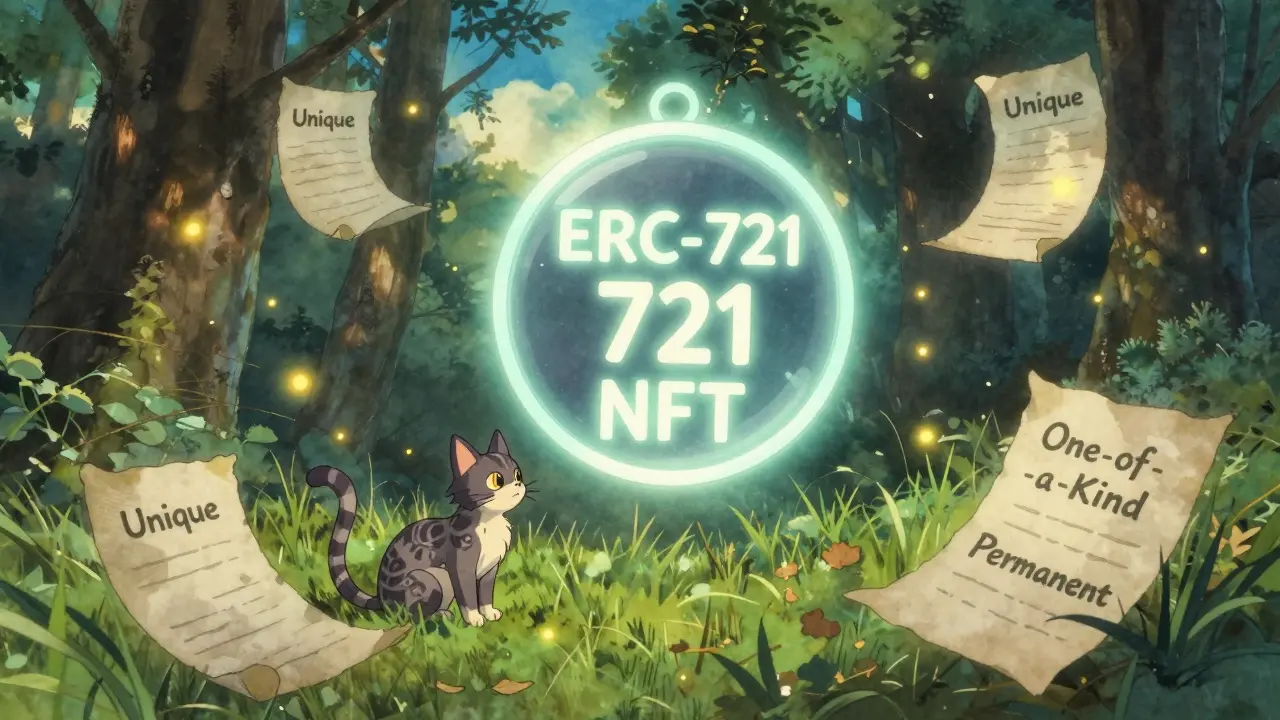
When you buy an NFT, you’re not just buying a JPEG or a clip. You’re buying a token - a digital certificate with rules baked into it. Those rules? They come from NFT standards. Without them, your NFT wouldn’t work on OpenSea, wouldn’t show up in your wallet, and couldn’t be traded across platforms. NFT standards are the invisible code that makes digital ownership possible. They decide how tokens are created, how they’re moved, who can own them, and even how they look on screen.
What Exactly Is an NFT Standard?
An NFT standard is a set of rules written into a blockchain’s smart contract system. Think of it like a language that all wallets, marketplaces, and apps agree to speak. If your NFT follows the ERC-721 standard, every platform that supports Ethereum knows exactly how to read it. No guesswork. No confusion.These standards define three core things:
- How the token is created (minted)
- How ownership is transferred
- How metadata (like the image or description) is linked
Without standards, every NFT project would build its own system. You’d need a different wallet for each collection. Selling your Bored Ape on one platform would mean re-uploading it to another. That’s chaos. Standards fix that. They’re the reason your NFTs work across apps.
ERC-721: The Original NFT Blueprint
ERC-721 was the first real NFT standard. It launched in early 2018 after being tested in CryptoKitties, the game where people bought and bred digital cats. Each cat was unique - no two were the same. That’s what made ERC-721 special. It forced the blockchain to treat each token as one-of-a-kind.Here’s how it works:
- Each token has a unique ID - no duplicates allowed.
- To transfer it, you need three things: your address, the receiver’s address, and the token ID.
- If the receiver is a smart contract (like a marketplace), it must be programmed to accept NFTs. Otherwise, the transfer fails.
That last part is critical. If you send an ERC-721 NFT to a wallet that doesn’t support it - say, an old wallet that doesn’t recognize NFTs - the token gets stuck. Forever. There’s no way to get it back. That’s why so many people lost NFTs in the early days. They didn’t know the receiver had to be compatible.
ERC-721 is still the most popular standard for digital art. OpenSea, SuperRare, and Foundation all rely on it. But it has a big flaw: one token per transaction. Want to send 10 NFTs? You need 10 separate transactions. At $1.85 per mint and 55 gwei gas prices, that’s $18.50 just to send a small collection. For artists minting thousands, that adds up fast.
ERC-1155: The Game Changer
Enter ERC-1155. Created by Enjin in 2018, this standard was built for games - not art. It lets you bundle multiple types of tokens into one contract. You can have fungible tokens (like in-game currency) and non-fungible tokens (like rare weapons) in the same smart contract.That changes everything.
- Transfer 100 NFTs in one transaction - gas cost drops by 90%.
- Mint 5,000 NFTs at once instead of one by one.
- Combine currency and items in a single trade.
Gas savings aren’t theoretical. Enjin’s benchmarks show ERC-1155 uses 17,000-20,000 gas per extra token. ERC-721? It’s 45,000-60,000 gas every single time. For a game like Axie Infinity, where players trade dozens of tokens daily, that’s $4-$5 saved per transaction. Multiply that by millions of users - that’s real money.
Developers love it. In 2023, 82% of new game projects chose ERC-1155 over ERC-721. Even big platforms like OpenSea now support it. But it’s not perfect. Managing mixed fungible and non-fungible tokens can get messy. Some developers report accounting errors when tracking hundreds of token types. Still, the efficiency wins.
ERC-721A: The Upgrade No One Saw Coming
ERC-721A isn’t a new standard - it’s a smarter version of ERC-721. It was created by a developer named Yuki in early 2022. His goal? Fix the gas problem without breaking compatibility.How? Batch minting.
Instead of minting one NFT at a time, ERC-721A lets you mint 10, 100, or even 1,000 in a single transaction. The gas cost doesn’t scale linearly. Minting 100 NFTs costs less than 10 times the gas of one - it’s closer to 2-3 times. One artist, NFTArtistMike, saved $387 on a 100-piece collection. Another saved $1,658 on 5,000 NFTs - a drop from $1,842 down to $184.
It’s still ERC-721. So your NFTs work on every marketplace that supports the original standard. But now, it’s cheaper. And faster. By Q3 2023, ERC-721A was powering 23% of new NFT projects - up from almost zero a year earlier. It’s the quiet upgrade that’s stealing market share from the original.
Other Standards: Sui, Tezos, and Bitcoin
Ethereum isn’t the only game in town. Other blockchains have their own standards.FA2 (Tezos) is similar to ERC-721 but uses a different programming language (Michelson). It’s popular in Europe for art and music NFTs. Lower fees. Less congestion. Same rules.
SIP-009 (Stacks) lets you create NFTs secured by Bitcoin. That means your digital asset is backed by the most secure blockchain in the world. It’s not as flashy as Ethereum, but for people who trust Bitcoin above all else, it’s the only option.
Sui’s Object Display is different. It doesn’t just define ownership - it defines how your NFT looks. Every NFT on Sui must include a name, description, image URL, and project link. The platform even lets creators choose whether to store the image on-chain (expensive but permanent) or off-chain (cheaper but riskier). Sui claims transfers take under 500 milliseconds - 30 times faster than Ethereum.
These standards aren’t just alternatives. They’re responses to Ethereum’s weaknesses: high fees, slow speeds, and complex rules.
Why Standards Matter Beyond Tech
Standards aren’t just code. They shape markets.Regulators are starting to notice. The EU’s MiCA law, which took effect in July 2024, requires NFT issuers to clearly state which standard their tokens use. Why? Because if your NFT is built on a standard that doesn’t support resale rights or royalties, the law wants you to say so.
Companies are too. Of the 67 Fortune 500 companies that launched NFTs by 2023, 42% used ERC-1155. Why? Because they’re not just selling art - they’re selling access, loyalty points, event tickets, and digital goods. They need multiple token types in one system.
And users? They’re voting with their wallets. 68% of NFT collectors still prefer ERC-721 for art - because it’s the original, the most trusted. But 82% of game developers pick ERC-1155. The right standard isn’t about what’s popular. It’s about what your use case needs.
What Happens When Standards Don’t Match?
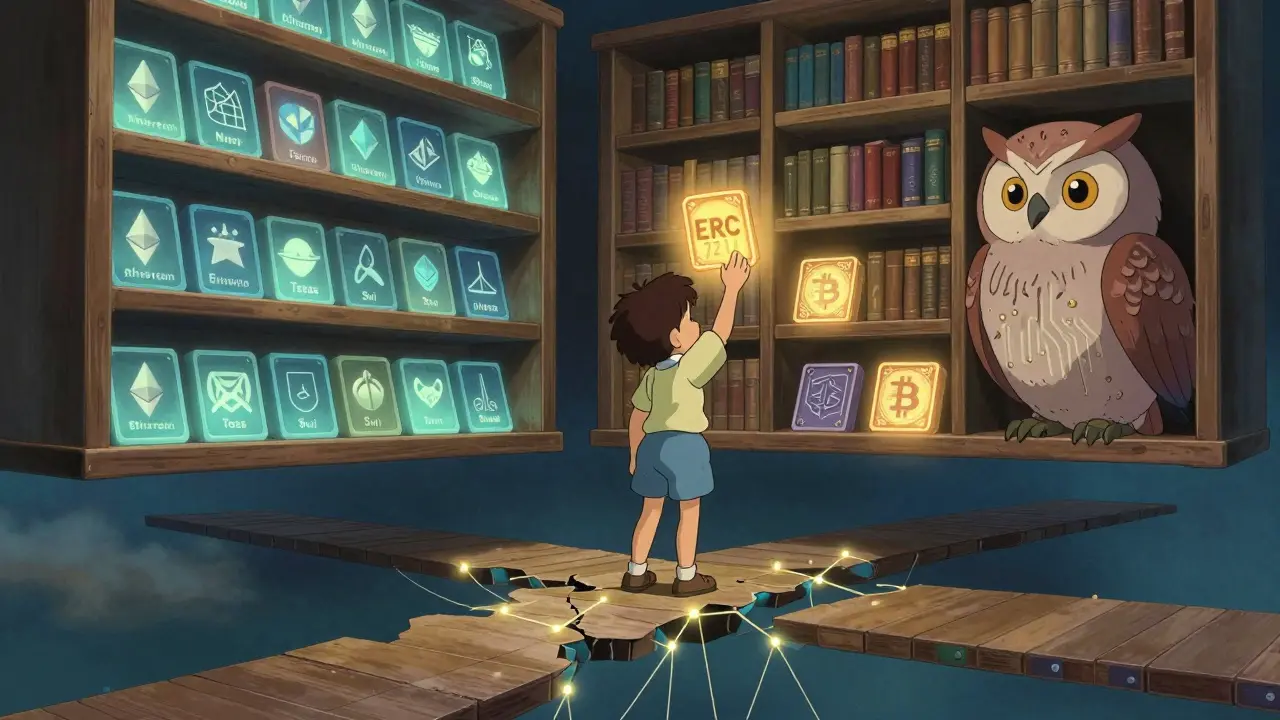
Here’s the scary part: not all platforms support all standards.If you mint an NFT on Sui and try to sell it on OpenSea, it won’t show up. If you send a Stacks NFT to a MetaMask wallet, it’ll look like an empty slot. Even worse - if you transfer an ERC-721 to a contract that doesn’t handle it, the token disappears. No error. No refund. Just gone.
Chainalysis found that 28% of NFT transfers fail because of standard mismatches. That’s nearly one in three. Most users don’t know why. They just think their wallet is broken.
That’s why interoperability matters. Platforms like ZeroEx now support ERC-721A and ERC-1155 together. Wallets are starting to auto-detect standards. But we’re still far from seamless.
What Should You Use?
If you’re an artist selling one-of-a-kind digital art? Use ERC-721 or ERC-721A. The community knows them. The market trusts them.If you’re building a game, a loyalty program, or a digital collectible with multiple items? Use ERC-1155. Save money. Save time. Scale easily.
If you’re in Europe and care about low fees? Look at FA2 on Tezos.
If you believe Bitcoin is the only secure chain? SIP-009 on Stacks is your only real option.
There’s no single best standard. There’s only the right one for your job.
The Future: More Standards, More Choice
Ethereum’s EIP-6454 is coming in 2024. It will let you temporarily delegate NFT ownership - like lending a rare item without giving up control. That’s huge for rental markets and gaming.Sui’s Object Display 2.1 now lets NFTs update their metadata dynamically. Imagine a concert ticket that changes its image when the lineup updates. That’s not possible on Ethereum today.
And BRC-69? A new Bitcoin NFT standard in development since mid-2023. If it gains traction, it could shift the entire NFT landscape.
One thing’s clear: the era of one standard to rule them all is over. The future is multi-standard. Platforms will need to support at least three. Users will need to understand them. And developers? They’ll have to pick wisely.





Write a comment
Your email address will be restricted to us