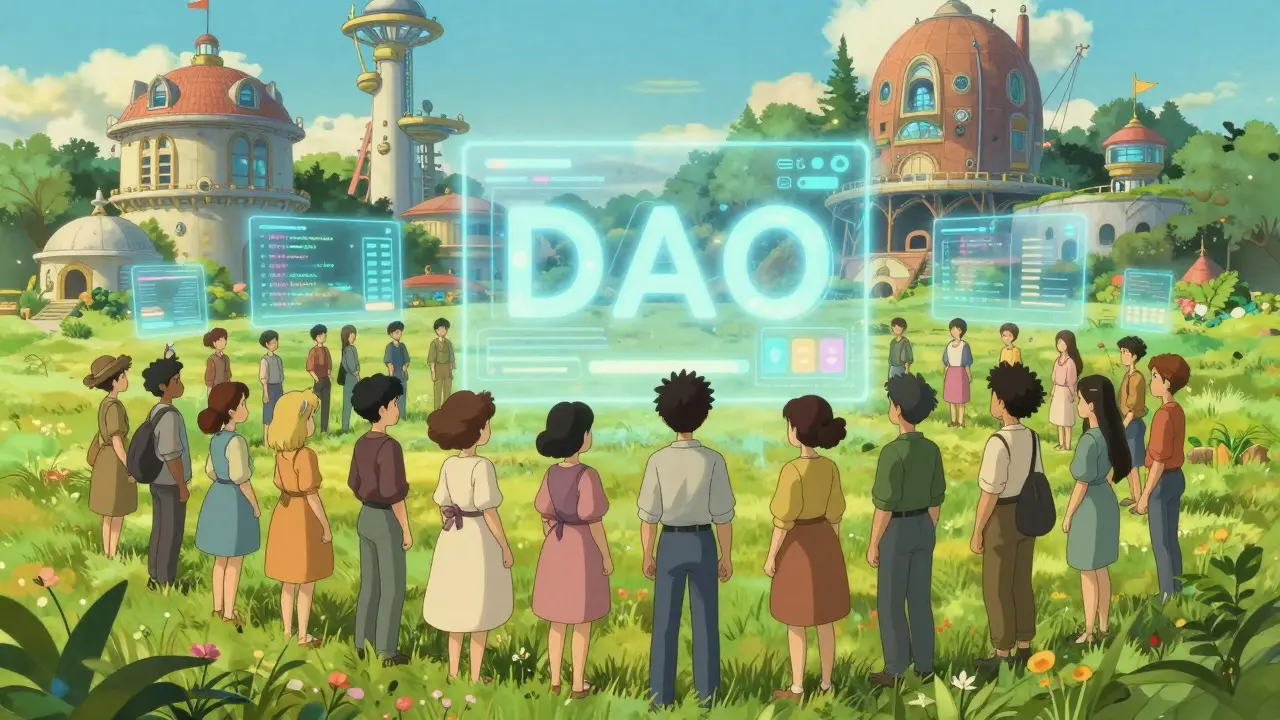
Imagine a group of strangers from across the globe pooling money to buy a minor league basketball team, or collectively deciding how to update a financial protocol that handles billions in assets. No CEOs. No boardrooms. Just code and community votes. This is the reality of Decentralized Autonomous Organizations (DAOs), which are digital entities governed by smart contracts and token-based voting rather than traditional hierarchies. While the concept sounds like science fiction, it has become a cornerstone of the Web3 ecosystem, representing a new internet architecture built on ownership, decentralization, and user-controlled data.
But not all DAOs succeed. Some have raised millions only to fail spectacularly due to poor coordination or legal hurdles. Others have revolutionized industries by offering unprecedented transparency. To understand whether DAOs are the future of work or just a passing trend, we need to look at the real-world evidence. We will examine famous examples, analyze why some thrive while others collapse, and break down what this means for you if you want to join or build one.
The Evolution: From The DAO Hack to Modern Governance
To understand today's landscape, you have to look back at where it all went wrong-and right. The first major attempt was simply called The DAO, launched in April 2016 as a venture capital fund built on Ethereum. It raised over $150 million before being hacked in June 2016. This event forced the Ethereum network to split via a hard fork, saving investors' funds but sparking a debate about immutability versus intervention.
Despite this rocky start, the sector matured rapidly. By Q3 2023, there were over 11,000 active DAOs managing more than $23 billion in treasury assets. The key difference between early experiments and modern DAOs is sophistication. Early versions relied on simple majority votes that could be manipulated by large holders. Today’s leaders use complex mechanisms like quadratic voting to ensure fairer representation. This evolution shows that while the technology is still young, the organizational design is becoming robust enough for serious economic activity.
DeFi Giants: Uniswap and Compound
The most successful DAOs often live in the world of Decentralized Finance (DeFi). These protocols handle massive amounts of value, making their governance critical. Uniswap is a leading decentralized exchange protocol that allows users to trade cryptocurrencies directly without intermediaries. Since its launch in 2018, it has processed over $1.2 trillion in trading volume. Its governance token, UNI, gives holders the power to propose changes to fee structures and treasury allocations.
However, scale brings challenges. Voter apathy is a significant issue; average turnout for Uniswap proposals hovers around 3%. This means a small fraction of users makes decisions affecting everyone. Similarly, Compound is a lending protocol that enables users to lend and borrow crypto assets algorithmically. Managing nearly $3 billion in total value locked, Compound faces similar participation issues. Yet, these DAOs remain vital because they offer transparency. Every transaction and vote is recorded on-chain, allowing anyone to audit the process-a stark contrast to opaque corporate decision-making.
| Feature | Uniswap | Compound |
|---|---|---|
| Primary Function | Decentralized Exchange (DEX) | Lending/Borrowing Protocol |
| Treasury Size (Approx.) | $1.5 Billion+ | $2.7 Billion TVL |
| Governance Challenge | Low voter turnout (~3%) | Voter fatigue and low engagement |
| Key Innovation | Automated Market Maker (AMM) | Algorithmic Interest Rates |
Investment Clubs: The LAO and Democratizing Venture Capital
If DeFi DAOs manage protocols, investment DAOs manage capital. The LAO stands for Libertarian Anarchist Organization, an investment DAO that pools funds to invest in early-stage startups. Founded in 2019, it has invested in 67 blockchain startups. With a treasury exceeding $32 million, The LAO demonstrates how DAOs can democratize venture capital. Instead of needing connections to Silicon Valley, anyone with tokens can participate in high-risk, high-reward investments.
However, regulatory hurdles are steep. Most jurisdictions require accredited investor status for such activities. The LAO navigates this by using a Delaware LLC structure, creating a hybrid model. This approach-combining on-chain voting with off-chain legal compliance-is now seen as best practice. Bain & Company found that such hybrid structures have a 68% higher survival rate than pure on-chain DAOs. This proves that ignoring real-world law is a recipe for failure, while embracing it ensures longevity.

Social Communities: Friends With Benefits (FWB)
Not all DAOs are about money. Some are about belonging. Friends With Benefits (FWB) is a social DAO focused on building a global community of builders, creators, and entrepreneurs. With over 12,000 members, FWB operates more like a digital club than a corporation. Members pay for membership, which grants access to events, networking, and collaborative projects.
The challenge for social DAOs is monetization and retention. Unlike DeFi protocols that generate revenue through fees, social DAOs rely on membership dues and brand partnerships. FWB struggles with the "free rider" problem, where many members consume content without contributing. Yet, it remains a powerful example of borderless community building. For remote workers and digital nomads, FWB provides a sense of tribe that traditional companies cannot match.
Philanthropy and Public Goods: Gitcoin and Giveth
Traditional charity is often criticized for lack of transparency. You give money, but do you know exactly how it was spent? Giveth is a philanthropy DAO platform that facilitates transparent donations to open-source projects and charities. Since 2017, it has facilitated $47 million in donations. Every dollar is tracked on the blockchain, providing donors with cryptographic proof of impact.
Similarly, Gitcoin is a platform that funds public goods in the Web3 ecosystem through quadratic funding mechanisms. Quadratic funding is a mathematical formula that amplifies the impact of small donations. If many people donate small amounts, the match pool contributes significantly more than if one person donates a large sum. This prevents plutocracy, where only the wealthy dictate outcomes. These models show how DAOs can solve real-world problems like underfunded public infrastructure.
Failures and Lessons: ConstitutionDAO and PleasrDAO
Success stories get the headlines, but failures teach us more. ConstitutionDAO was a temporary DAO formed in 2021 to bid on a rare copy of the U.S. Constitution. In just 72 hours, it raised $47 million from nearly 17,000 contributors. It came within inches of winning the auction before losing to a private collector. The DAO then dissolved, refunding members partially and donating the remainder to libraries.
What went wrong? Operational limitations. DAOs struggle to interface with traditional legal and financial systems quickly. Auction houses required specific legal entities to bid, which the DAO lacked. Another example is PleasrDAO, which failed in its attempt to purchase a Wu-Tang Clan album for $4 million due to internal governance disputes. Internal disagreements paralyzed decision-making, causing them to miss the deadline. These cases highlight two critical weaknesses: slow decision cycles (averaging 7-14 days) and difficulty interacting with non-crypto institutions.
How to Participate: A Practical Guide
If you are inspired to join a DAO, here is what you need to know. First, you need a cryptocurrency wallet. MetaMask is the most popular browser extension wallet for interacting with Ethereum-based dApps, used by over 30 million people. Second, you need governance tokens. These act as your voting rights. You can earn them by providing liquidity, contributing code, or simply buying them on exchanges.
Be prepared for a learning curve. Gitcoin’s 2023 survey found that effective participation takes 8-12 weeks. You must learn to read proposals, understand technical jargon, and engage in Discord discussions. Start with smaller DAOs to test the waters. Look for those with clear documentation and active moderators. Avoid DAOs with vague charters or concentrated voting power among a few whales.
The Future: Hybrid Models and Regulatory Clarity
Where do DAOs go from here? The trend is toward hybridization. Pure on-chain DAOs face legal gray areas. Only a handful of U.S. states like Wyoming and Utah have explicit DAO laws. The future belongs to entities that combine blockchain efficiency with traditional legal protection. Tools like Aragon provide comprehensive frameworks for setting up these hybrids.
Additionally, technology is improving. Snapshot 3.0 introduced gasless voting, removing the cost barrier for participants. As developer activity grows at 27% quarterly, expect more sophisticated tools for delegation, sub-voting, and automated execution. While skeptics dismiss DAOs as techno-utopian fantasies, the data suggests otherwise. They outperform traditional organizations in transparency metrics by 47%. As regulations clarify and tools improve, DAOs will likely move from niche experiments to mainstream organizational structures.
What is the biggest risk of joining a DAO?
The biggest risks are security vulnerabilities and regulatory uncertainty. Smart contract bugs can lead to loss of funds, as seen in early hacks. Additionally, since many jurisdictions lack clear laws for DAOs, members might face unexpected tax liabilities or legal ambiguities regarding liability.
Do I need to be a coder to participate in a DAO?
No, you do not need coding skills. While developers build the infrastructure, most DAOs need writers, designers, marketers, and community managers. Your contribution depends on the DAO's needs, not just technical expertise.
Why did ConstitutionDAO fail?
ConstitutionDAO failed primarily due to operational friction with traditional institutions. It could not meet the strict legal and identity requirements of the auction house in time, highlighting the difficulty of bridging decentralized groups with centralized legal frameworks.
Are DAOs legally recognized?
Recognition varies by location. In the U.S., states like Wyoming, Tennessee, and Utah have passed laws recognizing DAOs as legal entities. However, globally, most DAOs operate in a legal gray area, often using hybrid structures like LLCs to gain protection.
What is quadratic voting?
Quadratic voting is a mechanism where the cost of votes increases quadratically. This encourages broader consensus rather than domination by wealthy holders. It is widely used in philanthropy DAOs like Gitcoin to ensure public goods receive fair funding based on community interest, not just deep pockets.








Write a comment
Your email address will be restricted to us