Getting behind the wheel in the Sunshine State requires more than just knowing how to steer. The Florida driver's license application process is a structured legal procedure governed by the Department of Highway Safety and Motor Vehicles (FLHSMV) that verifies identity, residency, and driving competency. Whether you are a teenager getting your first permit or an adult moving to Florida from another state, the rules are strict. As of mid-2026, the system relies heavily on digital verification through the MyFloridaLicense.com portal, but it still demands physical presence for testing and document validation.
You cannot skip steps here. If you miss one document or try to apply before meeting the residency wait time, you will be turned away. This guide breaks down exactly what you need to do, who qualifies for exemptions, and how to avoid the most common pitfalls that delay new drivers.
Key Takeaways
- Residency Rule: New residents must live in Florida for 31 consecutive days before applying, though they must transfer their out-of-state license within 30 days of establishing residency.
- Document Precision: Hospital birth certificates and photocopies are rejected. You need original certified documents from the Bureau of Vital Statistics or a valid passport.
- The 12-Month Wait: Learner’s permit holders must keep their permit for at least 12 months without traffic violations before taking the final driving skills test.
- TLSAE Course: Mandatory for all applicants under 21 and most adults over 18, unless exempted by prior licensing history.
Establishing Your Eligibility and Residency
Before you fill out any forms, you need to determine if you are eligible to apply. The primary gatekeeper is residency. If you have recently moved to Florida, you cannot walk into a service center on day one. State law requires you to reside in Florida for 31 consecutive days before you can submit an application for a new license.
This creates a tricky overlap for new movers. While you must wait 31 days to *apply*, you are legally required to *transfer* your out-of-state license within 30 days of becoming a resident. How does this work? Typically, you establish residency (get your utilities set up, register to vote), wait the full 31 days, and then schedule your appointment. During those first 30 days, you may drive with your valid out-of-state license, but you must ensure you do not violate any local laws that could complicate your later application.
To prove residency, you need two documents showing your name and a Florida address. Acceptable proofs include:
- A utility bill (electric, water, gas) dated within the last 90 days.
- A rental agreement or lease contract.
- A mortgage statement.
- A Florida voter registration card.
- A school transcript listing your current address (for students).
If you lack these standard documents-perhaps you are staying with family-you can submit a Certification of Address Form along with two proofs of address belonging to the parent, guardian, or person you are living with. This form acts as a bridge when your name isn't on the bills yet.
Gathering Required Documentation
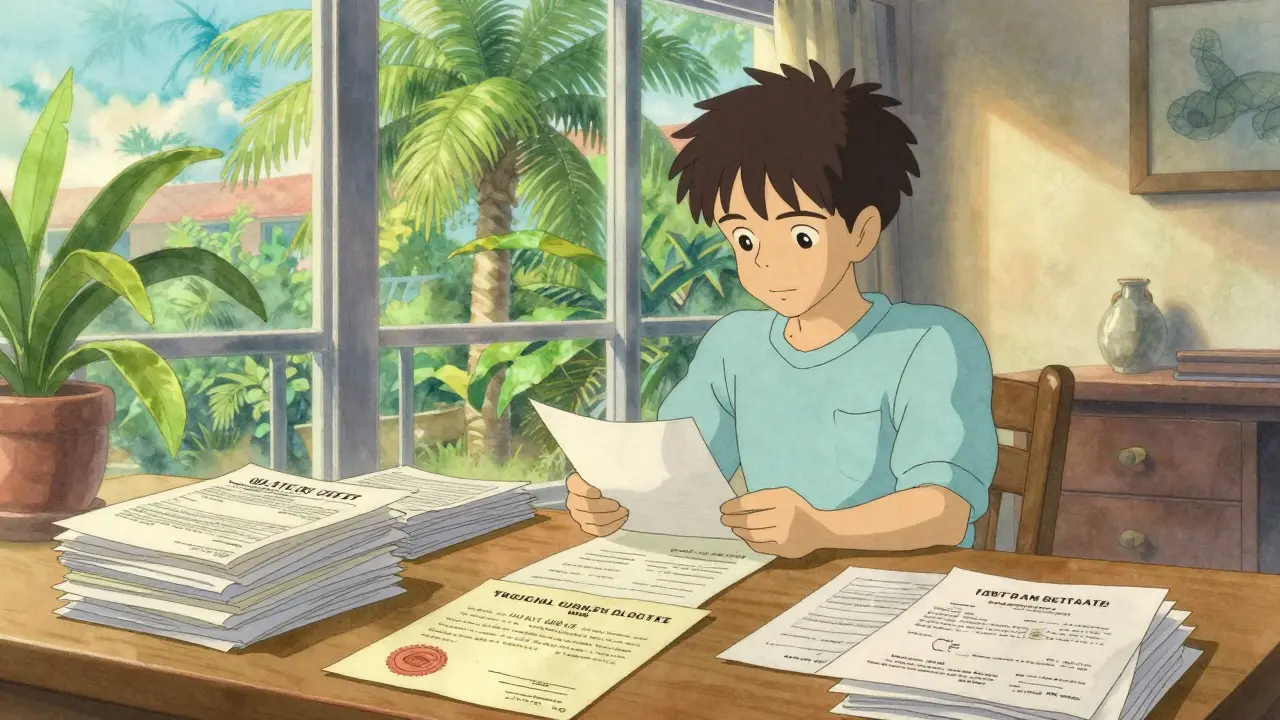
The most common reason applications fail is insufficient or invalid documentation. The FLHSMV is strict about originals. Photocopies are generally not accepted unless specifically noted. You need to gather three categories of proof: Identity, Social Security Number, and Residential Address.
| Category | Accepted Documents | Rejected Items |
|---|---|---|
| Identity | Original Birth Certificate (Bureau of Vital Statistics), Valid U.S. Passport, Permanent Resident Card | Hospital birth certificates, Photocopies of birth certificates, Expired passports |
| Social Security | Original Social Security Card, W-2 Tax Form, Paycheck stub with full SSN | SSN stickers, Partial numbers, Copies without wet signatures |
| Residency | Utility Bill, Lease Agreement, Mortgage Statement, Voter Registration | P.O. Boxes, Temporary housing letters (unless certified) |
For non-U.S. citizens, the requirements shift slightly. You must provide proof of legal presence, such as a valid visa or an Employment Authorization Document (EAD). The FLHSMV website maintains a detailed "What to Bring" section that categorizes documents for immigrants and nonimmigrants separately. Always check this list before leaving home, as bringing incorrect immigration docs will result in a denied appointment.

Education and Testing Requirements
Knowledge is tested in two ways: through coursework and written exams. The cornerstone of education for new drivers is the Traffic Law and Substance Abuse Education (TLSAE) course, which is a mandatory state-approved program teaching drivers about the dangers of alcohol and drugs while operating a vehicle.
Who needs to take the TLSAE course?
- All applicants under the age of 21.
- Applicants aged 18 and older who have never held a valid driver's license from any state.
You are exempt from the TLSAE course if you already hold a valid driver's license from another U.S. state or if you completed a driver education program approved by the Florida Department of Education. Many people use online providers like Aceable to complete this course quickly. It is self-paced and provides a certificate of completion that you must bring to your DMV appointment.
After completing the course, you face the Class E Knowledge Exam. This is a written test covering Florida traffic laws, road signs, and safe driving practices. You can take this exam online through authorized third-party providers or in-person at the DMV. Passing this exam grants you a learner's permit. Note that if you take the online knowledge exam, a parent or guardian must sign a Parent Proctoring Form, verifying they supervised the test.
The Learner's Permit Phase
Passing the written test doesn't mean you can drive alone. It means you enter the learner's permit phase. This period is designed to build experience under supervision. The rules differ significantly based on your age.
For Minors (Under 18):
If you are under 18, you must present a signed Parental Consent Form. This form must be signed in front of a DMV examiner or a notary public. You also need to track your driving hours. Before you can take the final driving skills test, you must complete 50 hours of supervised driving, including at least 10 hours at night. You will need a Certification of Minor Driving Experience Form signed by your parents and a licensed driver to prove this.
Driving Restrictions:
Your learner's permit comes with strict curfews. For the first three months, you can only drive during daylight hours. After three months, you may drive until 10:00 PM. At all times, you must be accompanied by a licensed driver who is at least 21 years old, or a licensed sibling who is 18 or older. No exceptions.
The 12-Month Holding Period:
This is the biggest hurdle for new drivers. You must hold your learner's permit for at least 12 months without any traffic convictions. If you get a ticket during this year, the clock resets. This rule ensures that new drivers have ample time to practice and demonstrate responsibility before handling a car unsupervised.
Scheduling and Taking the Driving Skills Test
Once you have held your permit for 12 months, completed your 50 hours of driving (if minor), and have no traffic violations, you are eligible for the final step: the Class E Driving Skills Test.
You cannot walk in for this test; you must schedule an appointment via MyFloridaLicense.com. On the day of the test, you will drive a DMV-owned vehicle with a licensed examiner. They will assess your ability to perform specific maneuvers:
- Parallel Parking: You must park smoothly between two cars without hitting curbs or vehicles.
- Three-Point Turns: Demonstrating control in tight spaces.
- Lane Changes: Proper signaling, mirror checking, and blind spot awareness.
- Intersection Control: Stopping completely at stop signs and yielding correctly.
Practice these maneuvers repeatedly before your test. Many candidates fail not because they can't drive, but because they forget to signal or roll too far past a stop line. Small errors add up.
Finalizing Your Application
After passing the skills test, you will undergo a vision and hearing screening at the DMV office. If you pass, you will pay the applicable fees and receive your temporary paper license. Your official plastic card will arrive in the mail within a few weeks.
Remember to bring your passing test results and all original documents to this final appointment. The DMV staff will verify everything one last time. If you missed a document earlier in the process, now is the time to fix it, but ideally, you should have prepared a checklist weeks ago to avoid this stress.
Can I get a Florida driver's license immediately after moving to the state?
No. You must establish residency and live in Florida for 31 consecutive days before you can apply for a new license. However, you must transfer your out-of-state license within 30 days of becoming a resident. This means you will likely need to wait until day 31 to submit your application, even though you are legally obligated to switch your license status shortly after arriving.
Is the TLSAE course required if I am over 18?
Yes, unless you are exempt. If you have never held a valid driver's license from any other state, you must take the Traffic Law and Substance Abuse Education (TLSAE) course. If you already have a valid license from another U.S. state, you are exempt from this requirement.
Will a hospital birth certificate be accepted for my ID?
No. The FLHSMV does not accept hospital birth certificates or photocopies. You must provide an original birth certificate issued by the Bureau of Vital Statistics or a valid U.S. Passport. Using an invalid ID will cause your application to be denied.
How long do I have to wait after getting my learner's permit to take the driving test?
You must hold your learner's permit for at least 12 months without any traffic convictions. Additionally, if you are a minor, you must complete 50 hours of supervised driving, including 10 hours at night, before you are eligible to schedule the driving skills test.
What happens if I get a traffic ticket while holding my learner's permit?
If you receive a traffic conviction while holding your learner's permit, the 12-month waiting period resets. You must start counting the 12 months again from the date of the violation clearance. This emphasizes the importance of safe driving during the permit phase.