
If you're looking for a crypto exchange that doesn't hold your keys, doesn't ask for your ID, and lets you trade across multiple blockchains without wrapping tokens, MOV Exchange might be worth your time. But it’s not another Uniswap clone. MOV isn’t just a DEX-it’s a trio of trading engines built on the Bytom protocol, each designed for a different kind of trader. Whether you’re doing high-frequency swaps, complex contract trades, or quick, low-slippage deals, MOV tries to cover all bases. But does it actually work in 2025? Let’s break it down.
How MOV Exchange Works: Three Trading Systems in One
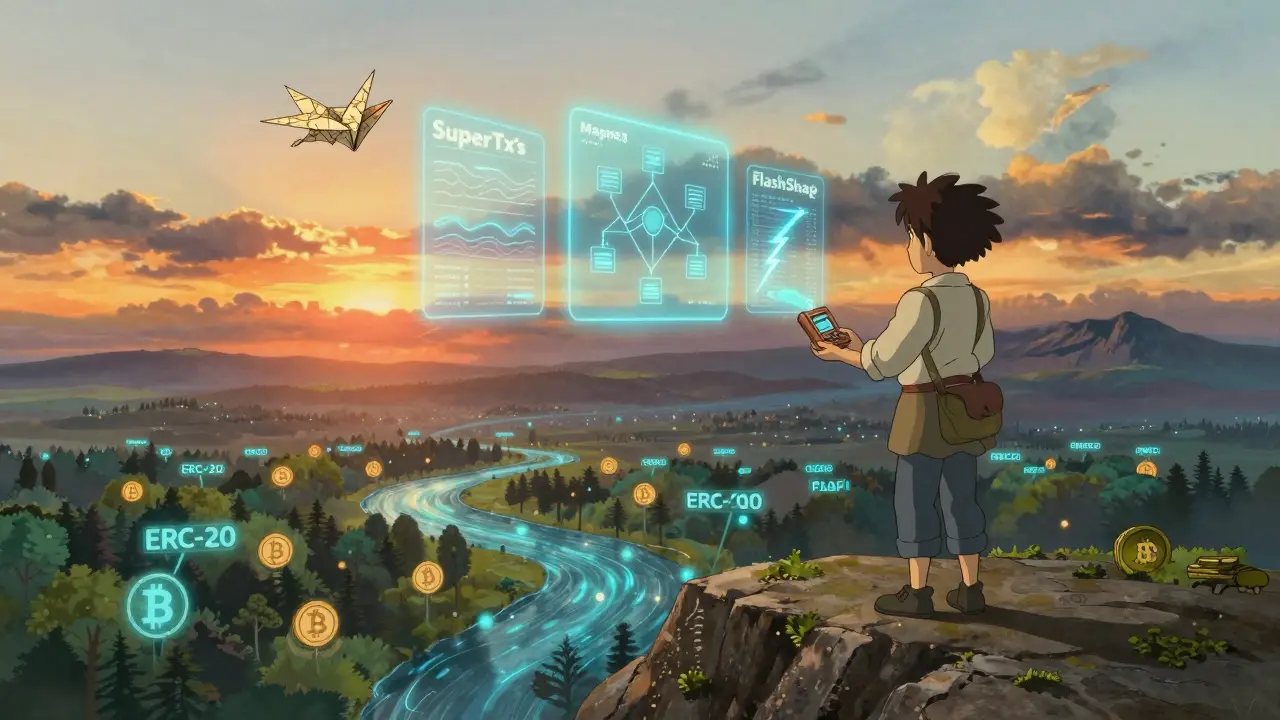
MOV Exchange doesn’t rely on one trading model. It runs three separate systems under the same roof: SuperTx, MagnEx, and FlashSwap. Each serves a different purpose, and understanding them is key to using the platform right.SuperTx is the constant function market maker (CFMM) engine. Think of it like Uniswap’s smarter cousin. It uses mathematical formulas to keep prices stable even when large trades happen. That means less slippage. If you’re swapping ETH for BTC or stablecoins, SuperTx gives you tighter spreads and lower fees than most AMMs. It’s built for traders who want predictable pricing without order books.
MagnEx is the contract-based trading layer. This is where you can set up conditional trades-like buying 100 MOV tokens only if BTC hits $60,000. It’s not for beginners. MagnEx lets you write on-chain logic that executes automatically when conditions are met. It’s ideal for hedging, arbitrage, or automated strategies. You’re not just trading-you’re programming trades.
FlashSwap is the speed layer. It matches orders off-chain using a fast, low-latency system, then settles them on-chain. This cuts down on gas fees and confirmation times. You get near-instant trade execution without sacrificing security. It’s perfect for traders who hate waiting for blockchain confirmations but still want full custody.
Why MOV Is Different from Other DEXs
Most decentralized exchanges stick to one model. Uniswap uses CFMM. dYdX uses order books. SushiSwap is a CFMM with yield farming. MOV is the only one combining all three in a single interface. That’s not just marketing-it’s technical architecture.It’s also built on Bytom, a blockchain designed for value exchange, not just payments. That means MOV has native support for multi-asset transactions and atomic swaps between different token types. You can trade BTC, ETH, and stablecoins without needing wrapped versions. That’s rare. Most DEXs require you to bridge assets through third-party protocols, which adds risk and cost.
And unlike centralized exchanges, MOV doesn’t store your funds. You connect your wallet-MetaMask, Rabby, or any EVM-compatible one-and trade directly. No KYC. No account freezes. No withdrawal limits. If you control your keys, you control your assets. That’s the core promise of DeFi, and MOV delivers it without the usual trade-offs.
Fees: No Platform Charges, But Blockchain Costs Still Apply
MOV Exchange doesn’t charge trading fees, deposit fees, or withdrawal fees. That’s a big deal. Most DEXs take a small cut-0.25% to 0.3%-on every trade. MOV takes zero. You only pay the network fees required by the blockchain you’re using.For example, if you’re trading on Ethereum, you’ll pay gas in ETH. If you’re using Polygon, you’ll pay in MATIC. If you’re swapping via Bytom’s native chain, you’ll pay in BTM. There’s no hidden markup. No liquidity provider fee baked into the price. What you see is what you pay.
That makes MOV attractive for high-volume traders. If you’re doing 10 swaps a day, saving even 0.2% per trade adds up fast. Over a month, that’s hundreds of dollars in saved fees.
Limitations: Liquidity and Adoption Are Still Challenges
MOV’s biggest weakness? Liquidity. Compared to Uniswap or PancakeSwap, MOV doesn’t have deep order books. You won’t find thousands of traders swapping large amounts of BTC or ETH here. That means for trades over $10,000, you’ll likely see slippage-even on SuperTx.It’s not a hack or a flaw. It’s just early-stage. MOV doesn’t have the same user base or marketing budget as the big players. Most retail traders still go to centralized exchanges like Binance or Coinbase because they’re easier, faster, and have more coins.
Also, there’s no mobile app. No customer support chat. No tutorial videos. The interface is clean, but it assumes you already know how to use wallets and DeFi. If you’re new to crypto, MOV will feel intimidating. There’s no hand-holding.
Is MOV Exchange Safe?
Yes-technically. Since it’s fully decentralized, there’s no central server to hack. No database of user emails or private keys. The smart contracts have been audited by third parties (though public reports are hard to find). The code is open-source on GitHub, so anyone can review it.But safety isn’t just about code. It’s about you. If you send funds to the wrong address? No recovery. If you lose your seed phrase? No reset button. MOV doesn’t have a ‘forgot password’ option. That’s by design. But it’s also why you need to be careful.
Also, be careful not to confuse MOV Exchange with Movement Network (MOVE token). They’re completely different. Movement launched its mainnet in December 2024 and had a massive price spike. MOV Exchange has nothing to do with that. Mixing them up could cost you money.
Who Should Use MOV Exchange?
MOV isn’t for everyone. Here’s who it’s best for:- Advanced DeFi users who want to trade across chains without wrapping assets
- Traders who hate fees and want to avoid platform markups
- Automated strategy builders who need contract-based execution (MagnEx)
- Privacy-focused users who don’t want to submit ID documents
It’s not for:
- New crypto users who need guided onboarding
- Large institutional traders needing deep liquidity
- People who want mobile apps or live support
What’s Missing? The Unknowns
There are big gaps in what we know about MOV:- What tokens are supported? The docs list BTC, ETH, USDT, and BTM-but are there others? Are ERC-20, BEP-20, and TRC-20 tokens all compatible?
- Is there a native MOV token? If so, what’s its role? Governance? Staking? Fee discounts?
- What’s the roadmap? Are they adding Layer 2 support? Multi-chain bridges? Any partnerships?
- Which countries can use it? Is it blocked in the U.S., UK, or EU?
Without answers to these, MOV feels like a powerful tool with unclear rules. You can use it today-but you’re flying blind on its future.
Final Verdict: A Niche Tool With Big Potential
MOV Exchange isn’t the easiest DEX. It’s not the biggest. But it’s one of the most technically interesting. It solves real problems-cross-chain trading, fee avoidance, contract-based execution-that other platforms ignore.If you’re comfortable with wallets, understand gas fees, and want to trade without surrendering control, MOV is worth testing. Start small. Try a $50 swap on SuperTx. See how fast it is. Then try setting up a conditional trade on MagnEx. See how flexible it is.
It won’t replace Binance or Coinbase. But for DeFi natives who want more control, more privacy, and fewer fees? MOV could become essential.
Is MOV Exchange a centralized or decentralized exchange?
MOV Exchange is fully decentralized. It doesn’t hold users’ funds, doesn’t require KYC, and runs on smart contracts. You trade directly from your wallet using your private keys. There’s no central server or company controlling the platform.
Does MOV Exchange charge trading fees?
No, MOV Exchange doesn’t charge any trading, deposit, or withdrawal fees. You only pay the network gas fees required by the blockchain you’re using-like Ethereum, Polygon, or Bytom. This makes it cheaper than most DEXs that take a percentage per trade.
What’s the difference between SuperTx, MagnEx, and FlashSwap?
SuperTx uses a constant function market maker (CFMM) for low-slippage swaps, ideal for quick trades. MagnEx lets you create on-chain contracts to execute trades under specific conditions-like buying when a price hits a target. FlashSwap matches orders off-chain for speed and settles them on-chain for security. Together, they cover different trading styles.
Can I trade Bitcoin on MOV Exchange?
Yes, MOV supports Bitcoin via its cross-chain protocol. You can trade BTC against other assets like ETH or stablecoins without wrapping it into an ERC-20 token. This is rare among DEXs and gives you direct access to Bitcoin’s value without third-party bridges.
Is MOV Exchange available in the UK or USA?
There’s no official statement on geographic restrictions. Since MOV doesn’t require KYC, it’s technically accessible from most countries. However, users in regulated jurisdictions like the UK or USA should check local crypto laws before using any decentralized exchange, as regulatory gray areas still exist.
Is MOV Exchange the same as Movement Network (MOVE token)?
No, they are completely different. MOV Exchange is a DeFi trading platform built on Bytom. Movement Network (MOVE) is a Layer 1 blockchain launched in December 2024 with its own token and ecosystem. Confusing the two could lead to sending funds to the wrong address.
Do I need a special wallet to use MOV Exchange?
No, you can use any EVM-compatible wallet like MetaMask, Rabby, or Trust Wallet. MOV doesn’t require a custom wallet. Just connect your existing one, approve the transaction, and start trading. Make sure you’re on the correct network (Ethereum, Polygon, or Bytom) before swapping.






Write a comment
Your email address will be restricted to us