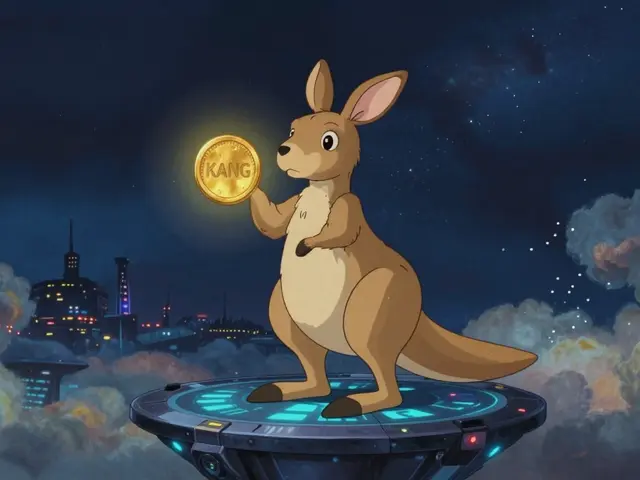
Ever scrolled through a list of thousands of cryptocurrencies and wondered what on earth "Kangamoon" actually is? You aren't alone. In the chaotic world of digital assets, new tokens pop up daily, often promising the moon-or in this case, aiming for it with a kangaroo mascot. Kangamoon (KANG) is a community-driven cryptocurrency that blends meme culture with gaming and social finance. It launched in May 2024 as an ERC-20 token on the Ethereum network, positioning itself not just as a joke coin, but as a platform where users can interact, grow, and earn through integrated Play-to-Earn (P2E) mechanics.
But does it deliver on that promise, or is it just another speculative asset waiting to fade away? Let's break down what Kangamoon really is, how it works, and whether it deserves a spot in your portfolio or watchlist.
The Core Concept: More Than Just a Meme?
Most meme coins start as internet jokes-Dogecoin was born from a meme, after all. Kangamoon tries to evolve that model. It belongs to a specific sub-category of crypto known as Game-Fi and Social-Fi. Instead of relying solely on hype and community shilling, the project claims to build an ecosystem where holding $KANG gives you utility within games and social platforms.
Here is the pitch: Kangamoon aims to be the "next top meme coin" by creating a strong community of enthusiasts who don't just trade the token but use it. The integration of a Play-to-Earn game is supposed to give the token functional value. In theory, this means you could earn $KANG by playing games, which creates demand beyond simple speculation. However, at its current stage, the project is still heavily reliant on its narrative rather than proven, large-scale adoption.
Technical Specifications: Under the Hood
To understand if Kangamoon is legitimate, we need to look at the technical facts. These are the hard numbers that don't change based on marketing fluff.
- Blockchain: Ethereum (ETH)
- Token Standard: ERC-20 (This means it’s compatible with most Ethereum wallets like MetaMask and exchanges like Uniswap).
- Contract Address: 0xB1c9D42FA4bA691eFe21656A7e6953d999B990c4
- Total Supply: 1,000,000,000 (1 Billion) KANG
- Launch Date: May 7, 2024
The fixed supply of 1 billion tokens is a key detail. Unlike some inflationary tokens, there is a cap. This scarcity *could* theoretically support price appreciation if demand increases, but only if those tokens are actually circulating and being used. Currently, data on circulating supply is fragmented, which makes calculating a true market capitalization difficult across different platforms.

Price Volatility and Market Data Reality Check
If you check the price of Kangamoon right now, you might see conflicting numbers depending on which website you visit. This is normal for micro-cap tokens with low liquidity. Here is a snapshot of the data landscape as of mid-2026:
| Platform | Approximate Price (USD) | 24h Volume | Market Cap Status |
|---|---|---|---|
| CoinGecko | $0.0001039 | $188.48 | Low / Unclear |
| CoinCarp | $0.000291 | $67,795 | Variable |
| Crypto.com | $0.0004124 | $122,571 | Variable |
| Binance Tracker | $0.000341 | $83,625 | Listed as $0 (Data Gap) |
| MetaMask | $0.00008986 | $2.07 | Blank |
Notice the massive difference between CoinGecko ($0.0001) and Crypto.com ($0.0004). Why? Because Kangamoon has low liquidity. When few people are buying and selling, small trades can swing the price significantly. Also, many major aggregators list the market cap as "$0" or "unknown" because they cannot verify the exact circulating supply. This is a red flag for serious investors-it means the token isn't yet widely tracked or trusted by institutional-grade data providers.
Historically, Kangamoon has been extremely volatile. Its all-time high was around $0.15, while recent lows have dipped below $0.0001. That is a drop of over 99%. If you bought at the peak, you are down significantly. If you buy now, you are betting on a massive recovery.
Where Can You Buy Kangamoon?
You won't find Kangamoon on major centralized exchanges like Coinbase Pro or Binance Spot markets for direct fiat purchase. Instead, it lives primarily on decentralized exchanges (DEXs).
The most active trading pair is KANG/WETH on Uniswap V2. Here is how you typically acquire it:
- Set up a Wallet: Download MetaMask or Trust Wallet. Ensure you are connected to the Ethereum network.
- Get ETH: Buy Ethereum (ETH) on a central exchange and send it to your wallet. You will need ETH to pay for gas fees (transaction costs) and to swap for KANG.
- Connect to Uniswap: Go to Uniswap.app and connect your wallet.
- Swap: Paste the official contract address (0xB1c9...) to ensure you get the real token. Swap your WETH for KANG.
Be careful. Scammers often create fake tokens with the same name. Always double-check the contract address against reliable sources like CoinMarketCap or CoinGecko before swapping.
Risks and Red Flags to Consider
Before you throw money at Kangamoon, let's talk about the risks. This is not Bitcoin or even Solana. It is a high-risk, speculative asset.
- Lack of Transparency: There are no named founders or a public founding organization listed on major aggregators. Anonymous teams are common in meme coins but increase the risk of a "rug pull" (where developers abandon the project and take the funds).
- Low Liquidity: With daily volumes sometimes under $200 on primary DEX pairs, selling a large amount of KANG could crash the price instantly. You might get stuck holding tokens you can't sell without losing half their value.
- Unproven Utility: While the P2E (Play-to-Earn) concept sounds great, there is little evidence of widespread user adoption or revenue generation from these games yet. Without real users playing and earning, the token lacks fundamental value support.
- Data Fragmentation: The fact that major platforms struggle to report accurate market caps suggests the project is still in its infancy or struggling with on-chain data verification.
Is Kangamoon Worth Your Attention?
Kangamoon sits in a crowded space. Thousands of meme coins launch every year, and very few survive past their first year. What sets KANG apart on paper is its attempt to merge meme culture with actual utility via Game-Fi and Social-Fi. If their Play-to-Earn games gain traction, the token could see renewed interest.
However, until you see consistent volume, clear team identity, and verifiable user growth, treat Kangamoon as a lottery ticket, not an investment. Only spend what you can afford to lose entirely. For most investors, sticking to established assets with transparent fundamentals is safer. But if you love the thrill of hunting for the next big thing in the crypto jungle, Kangamoon offers a cheap entry point-with a very high chance of failure.
What is the total supply of Kangamoon (KANG)?
The maximum total supply of Kangamoon is fixed at 1,000,000,000 (1 billion) tokens. This cap is defined in its smart contract on the Ethereum blockchain.
Is Kangamoon a safe investment?
Kangamoon is considered a high-risk investment. It has low liquidity, anonymous leadership, and extreme price volatility. Most meme coins fail, so investors should only allocate funds they are prepared to lose completely.
How do I buy Kangamoon tokens?
You can buy KANG on decentralized exchanges like Uniswap V2. You will need an Ethereum wallet (like MetaMask), some ETH for gas fees, and the correct contract address to swap ETH for KANG.
What blockchain is Kangamoon built on?
Kangamoon is an ERC-20 token built on the Ethereum blockchain. This makes it compatible with standard Ethereum wallets and decentralized applications.
Does Kangamoon have any real-world utility?
The project claims to integrate Play-to-Earn (P2E) gaming and Social-Fi features, allowing users to earn tokens through gameplay and social interaction. However, widespread adoption and revenue from these utilities are not yet clearly documented.
Why is the market cap of Kangamoon often listed as $0?
Many data aggregators list the market cap as $0 because they lack verified data on the circulating supply. Without knowing exactly how many tokens are actively in circulation, they cannot calculate an accurate market capitalization.