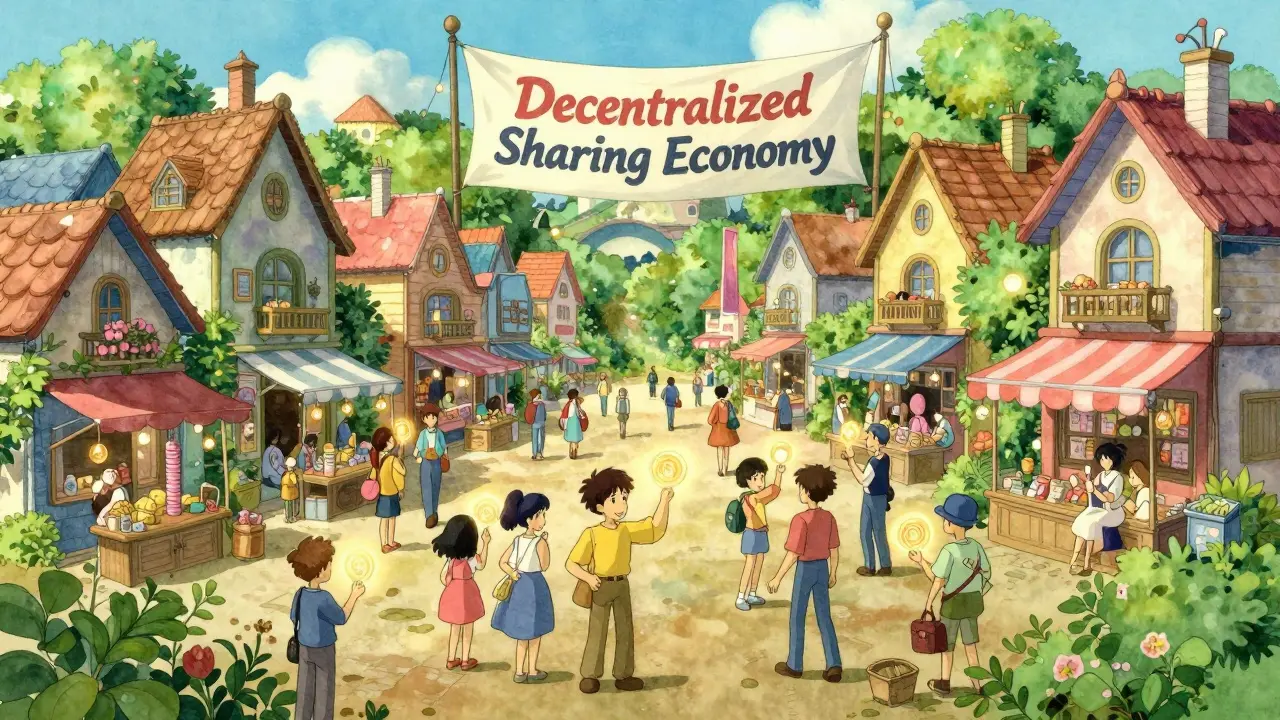
Remember the days when every new blockchain project promised to revolutionize how we share resources? Swarm City (SWT) was one of those projects. Launched in 2016, it aimed to create a decentralized sharing economy on the Ethereum blockchain. But today, if you are looking up what Swarm City is, you are likely staring at a price chart that looks like a cliff face and wondering where all the value went.
The short answer? Swarm City is effectively a ghost town. It is a dormant cryptocurrency from the early boom cycle of ICOs that failed to deliver on its promises. While the code still exists on the blockchain, the community, development, and liquidity have vanished. For anyone holding these tokens or considering buying them, understanding the history and the hard reality of SWT is crucial before you lose any more money or hope.
The Original Vision: Decentralized Airbnb?
To understand why Swarm City failed, you first have to look at what it tried to be. Back in late 2016, the idea of a peer-to-peer sharing platform was hot. Think of it as trying to build an Airbnb or TaskRabbit without the central company taking a cut. The vision was noble: users could post requests for services or goods, and other users could fulfill them, with transactions handled directly via smart contracts.
The core concept relied on storing user data locally on individual devices rather than on centralized servers. This approach promised privacy and resilience. If one server went down, the network survived. The native currency, the SWT token, was designed to facilitate these exchanges. You would pay someone in SWT to clean your house or rent out your spare room, bypassing traditional payment processors entirely.
However, there was a massive flaw in this logic. Trustless systems require robust reputation mechanisms. How do you know the person renting your couch won't trash it if there is no central authority to ban them? Swarm City struggled to solve this "trust" problem. Without a strong incentive structure or a functioning dispute resolution system, users had little reason to engage with the platform over established competitors like Airbnb or Uber.
The ICO Hype and the Crash
Let's talk about the numbers, because they tell the story of speculative mania. Swarm City launched its Initial Coin Offering (ICO) on October 31, 2016. At that time, enthusiasm for blockchain was sky-high. The project raised approximately $841,350 USD. The initial price per token was around $0.088.
Then came the bull run of 2017. As Bitcoin surged, altcoins followed suit, often driven by hype rather than utility. Swarm City’s token price skyrocketed, reaching an all-time high of $19.74 on March 6, 2017. That is a staggering increase from the ICO price. Investors were euphoric. Social media feeds were filled with predictions that SWT would reach hundreds of dollars.
But bubbles always burst. By 2018, the market corrected. Projects without real products or active user bases saw their prices evaporate. Swarm City had no working product to show for the millions raised. The price began a long, painful decline. By March 2021, the token hit an all-time low of roughly $0.0009. Today, depending on which exchange or data aggregator you check, the price hovers near zero, with significant discrepancies between platforms due to lack of trading volume.
Current Status: Is SWT Still Alive?
If you are checking the status of Swarm City in June 2026, here is the harsh truth: the project is dead. Let's break down what that means in practical terms.
- No Liquidity: Liquidity refers to how easily you can buy or sell an asset. For SWT, liquidity is non-existent. Major exchanges like Binance have delisted the token. There are only a handful of obscure markets left, and even then, trades are rare. The last recorded trade activity was months ago, with negligible volume.
- Zero Market Cap: Because the price is essentially zero and trading has stopped, the market capitalization is listed as $0 USD on most major tracking platforms. This means the total value of all outstanding tokens is worthless in practical terms.
- Abandoned Development: Open-source projects can theoretically be revived by the community. However, there is no evidence of active developers, regular updates, or community governance. The GitHub repositories associated with the project show no recent commits. The social media channels are silent or filled with bots.
- Inconsistent Data: You might see conflicting information online. Some sites list the circulating supply as 8.5 million tokens, while others show zero. This confusion arises because the token is no longer actively traded or verified by major data providers.
The holder count stands at around 3,280 addresses. These are likely people who bought in during the 2017 hype and never sold, or traders who got stuck when the exchanges closed. They are holding digital receipts for a service that no longer exists.

Why Did Swarm City Fail?
It is easy to criticize failed projects in hindsight, but analyzing why they fail helps us avoid similar traps in the future. Swarm City suffered from several critical issues common to the 2016-2017 ICO era.
1. Lack of Product-Market Fit
The idea of a decentralized sharing economy is sound, but executing it is incredibly difficult. Swarm City did not have a working app when it raised funds. Instead of building the product, the team focused on marketing and speculation. When the hype died, there was nothing left for users to interact with.
2. Regulatory Pressure
As governments began to scrutinize cryptocurrencies, many unregistered securities faced legal challenges. While Swarm City wasn't explicitly shut down by regulators, the changing landscape made it harder for such projects to operate openly or partner with legitimate businesses.
3. Technical Complexity vs. User Experience
Using Ethereum smart contracts for simple tasks like renting a bike requires users to manage wallets, gas fees, and private keys. In 2016, this was too complex for the average consumer. Centralized platforms offered a smoother experience, drawing users away from the cumbersome Swarm City interface.
4. Team Transparency Issues
Many early ICO teams were anonymous or provided vague backgrounds. Without a track record or public accountability, trust eroded quickly when progress stalled. Investors realized they had sent money into a void.
Comparison: Swarm City vs. Successful Decentralized Platforms
| Feature | Swarm City (SWT) | Airbnb (Centralized) | Gitcoin (Active DeFi) |
|---|---|---|---|
| Status | Dormant / Abandoned | Active / Publicly Traded | Active / Growing |
| Blockchains Used | Ethereum (Legacy) | Traditional Web2 Servers | Ethereum, Polygon, Solana |
| User Base | ~3,280 Holders (Inactive) | Millions of Active Users | Tens of Thousands of Developers |
| Liquidity | None | High (Stock Market) | High (DEXs & CEXs) |
| Primary Use Case | P2P Sharing (Failed) | Travel Accommodation | Funding Open Source Software |
This comparison highlights the gap between promise and execution. Airbnb succeeded by solving the trust issue through insurance and reviews, even though it is centralized. Gitcoin succeeded by finding a niche (funding developers) and building a genuine community. Swarm City had neither a clear niche nor a community to sustain it.
Risks of Holding or Buying Dead Tokens
You might be thinking, "If I hold onto SWT, maybe it will come back." This is a dangerous mindset known as "hopium." Here is why you should treat SWT as a loss.
Opportunity Cost: Every dollar tied up in a dead token is a dollar not invested in something productive. Whether it's index funds, stablecoins earning yield, or even just keeping cash in a high-interest savings account, your money is better spent elsewhere.
Scam Risks: Dead projects attract scammers. You may see fake announcements claiming that Swarm City is "relaunching" or that a new exchange is listing SWT. These are phishing attempts designed to steal your remaining tokens or private keys. Never click links from unsolicited messages regarding SWT.
Technical Obsolescence: The Ethereum network has evolved significantly since 2016. With upgrades like EIP-1559 and the move to Proof-of-Stake, older smart contracts may become incompatible or too expensive to interact with. Even if someone wanted to revive Swarm City, the technical debt would be immense.
Lessons Learned for Crypto Investors
Swarm City serves as a cautionary tale for the broader cryptocurrency space. What can we take away from its demise?
- Utility Over Hype: Always ask what the product actually does. Does it solve a real problem? If the only reason to buy the token is to sell it to someone else for more money, it is a pyramid scheme, not an investment.
- Team Transparency Matters: Do your due diligence on the people behind the project. Are they public? Do they have relevant experience? Anonymous teams are a red flag.
- Check the Code: For tech-savvy investors, checking the GitHub repository is essential. Regular commits indicate active development. Silence indicates abandonment.
- Liquidity is Key: If you cannot easily sell an asset, it is not an investment; it is a lottery ticket. Avoid tokens with low trading volumes or those listed only on obscure exchanges.
The crypto market is maturing. While there are still risky projects, the days of blindly investing in any ICO are over. Tools like CoinMarketCap, CoinGecko, and independent research communities help filter out the noise. Use them.
Final Thoughts on Swarm City
Swarm City (SWT) was a well-intentioned experiment in decentralized commerce that ultimately failed to gain traction. Its rise and fall mirror the broader volatility of the early cryptocurrency market. For those who lost money, it is a painful lesson. For new investors, it is a warning sign.
There is no indication that Swarm City will make a comeback. The technology has moved on, the community has dispersed, and the financial incentives for revival are nonexistent. If you hold SWT, consider it a sunk cost. Focus your energy and capital on projects with active development, transparent teams, and real-world utility. The blockchain space is full of innovation, but you have to know where to look-and where to stay away.
Is Swarm City (SWT) a scam?
While Swarm City may not have been an intentional scam at launch, it exhibits characteristics of a failed project. The team raised funds through an ICO but failed to deliver a functional product or maintain development. Many investors view it as a scam due to the loss of value and lack of transparency, but legally, it is largely considered an abandoned venture rather than a proven fraud case.
Can I still buy SWT tokens?
Technically, you might find a few obscure exchanges or peer-to-peer platforms where SWT is listed, but it is highly discouraged. Liquidity is virtually zero, meaning you may not be able to sell the tokens later. Major exchanges like Binance and Coinbase have delisted SWT due to lack of activity and compliance concerns.
What happened to the Swarm City team?
The original team behind Swarm City disappeared from public view after the initial hype faded. There have been no official communications, updates, or roadmaps released in years. Their social media accounts are inactive, and there is no current leadership managing the project.
Is the SWT token worth anything in 2026?
No, the SWT token has negligible to zero value in 2026. The market cap is listed as $0 on most platforms, and there is no active trading volume. Any price shown on minor aggregators is likely outdated or based on manipulated micro-trades. It holds no intrinsic value.
How is Swarm City different from Ethereum Name Service (ENS)?
Swarm City attempted to create a general-purpose sharing economy platform, whereas ENS focuses specifically on providing human-readable names for blockchain addresses. ENS succeeded because it solved a specific, urgent technical problem in the Ethereum ecosystem. Swarm City failed because it tried to compete with established centralized platforms without offering a superior user experience.




Write a comment
Your email address will be restricted to us