
The core problem most people face is distinguishing the legitimate Bird Finance ecosystem from the noise. While many airdrops promise instant wealth, the reality of the BIRD distribution has been marked by shifting timelines and complex requirements. To get your tokens, you need to understand exactly how their smart pools work and why their tokenomics are designed to be hyper-deflationary.
What is Bird Finance and the BIRD Token?
Before chasing the tokens, let's clarify what this project actually does. Bird Finance is a DeFi platform that utilizes smart pool functionality and lending services to automate reward mining. Basically, instead of you manually searching for the highest yield on ten different chains, their algorithms do the heavy lifting to compound returns for you.
The engine driving this is the BIRD token, the native governance token of the Bird Finance ecosystem. It isn't just a reward token; it's a tool for governance. If you hold BIRD, you get a say in which mining pools the platform integrates next and how the project evolves.
The BIRD Tokenomics: A Deflationary Machine
Bird Finance uses a pretty aggressive approach to keep its token supply tight. Right at the start, 50% of the total BIRD supply was sent to a "blackhole" address. In plain English, those tokens are gone forever. They can't be traded, sold, or claimed.
But the deflation doesn't stop there. Every time someone sends BIRD, a 6% transaction fee is triggered. This isn't just a random tax; it's split three ways to support the ecosystem:
- 2% to the Liquidity Pool: This ensures there's enough trading volume on decentralized exchanges so you can actually buy or sell your tokens without massive price swings.
- 2% to the DAO Governance Pool: This fund is used to pay for community-led decisions and platform development.
- 2% to BIRD Holders: This is the "passive income" part. If you hold the token, you get a slice of every transaction happening on the network.
Because the blackhole address holds the biggest chunk of tokens, the system creates a constant loop of deflationary pressure. Every transaction effectively reduces the circulating supply, which is a classic move to try and push the price upward over time.

Breaking Down the BIRD Airdrop Eligibility
If you're wondering if you qualify for the airdrop, you need to look at the specific interaction requirements. Airdrops aren't usually just "free money"; they are rewards for early adopters who provided value to the network. For Bird Finance, the eligibility criteria generally fell into a few buckets:
- Token Holding: You likely needed to hold a minimum amount of specific assets or BIRD tokens in a compatible wallet.
- Social Engagement: Following their official accounts and interacting with their community posts.
- Wallet Connectivity: Connecting your wallet to the official airdrop portal to verify ownership of the required assets.
- Task Completion: Filling out registration forms and completing specific on-chain activities.
It's important to be honest about the timeline. There was a lot of noise about a November 2024 listing, which then slid into the first quarter of 2025. In the world of DeFi, delays are common, often caused by security audits or regulatory hurdles. If you haven't seen your tokens yet, it's likely due to these shifting schedules.
The "BIRD" Confusion: Avoiding the Wrong Project
This is where most people get tripped up. There are at least three different "BIRD" projects floating around, and they have absolutely nothing to do with each other. If you're looking for the DeFi smart pool platform, don't accidentally join a gaming bot.
| Project Name | Primary Function | Blockchain/Platform | Core Goal |
|---|---|---|---|
| Bird Finance | DeFi Smart Pools | Solana, Ethereum, HECO, OKExChain | Automated Yield Farming |
| Birdchain | Instant Messaging | Independent Chain | Decentralized Communication |
| Birds (Mini App) | Gaming/Social | Sui Blockchain | On-chain Activity Rewards |
If a site asks you to join a Telegram bot and reach "Level 10" to get BIRD tokens, you're likely dealing with the Sui-based game, not the DeFi platform. Always double-check the URL and the blockchain network before connecting your wallet.
How the Multi-Mining System Actually Works
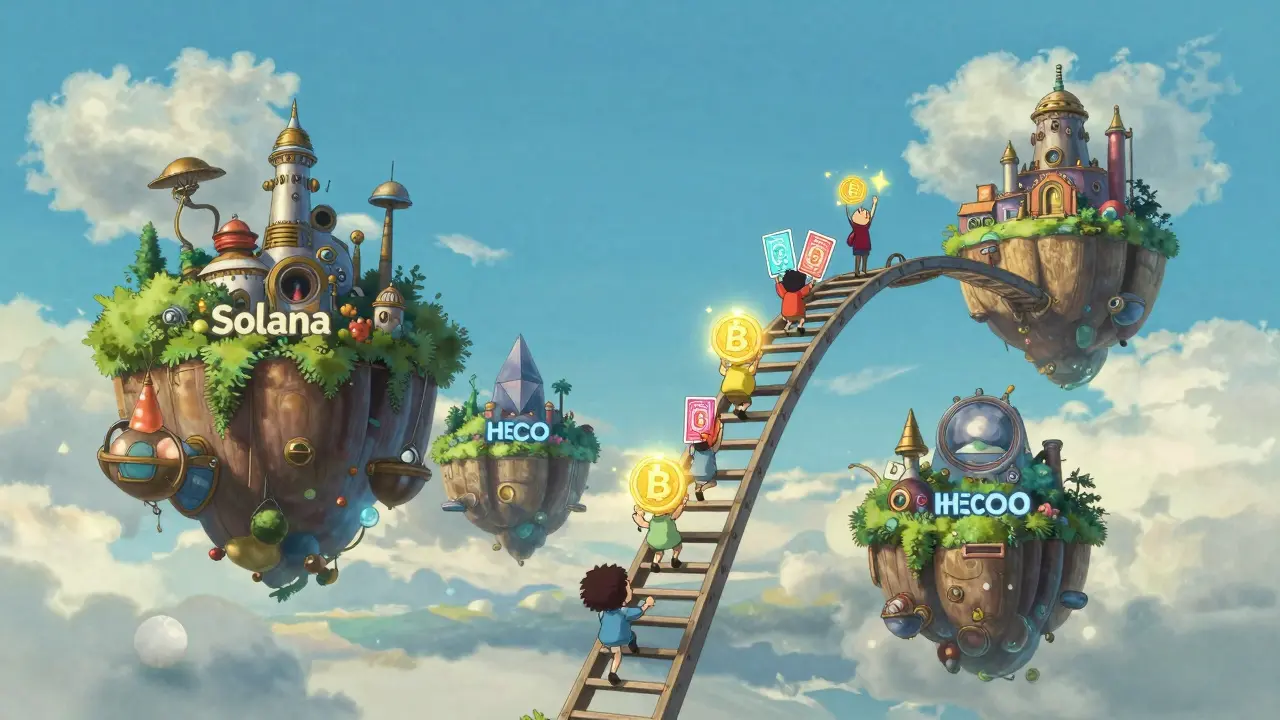
The real value of Bird Finance isn't in the airdrop, but in the cross-chain integration strategy. They operate across Solana, Ethereum, HECO, and OKExChain. To make money here, they use a four-step process that looks like a ladder:
- Step 1: You stake your main assets to start auto-compounding mining, which earns you Btokens.
- Step 2: You take those Btokens and put them into liquidity pools to earn actual BIRD tokens.
- Step 3: You can use Btokens to mint NFT cards, which often provide boosts to your earnings.
- Step 4: You stake Btokens specifically to unlock even more BIRD rewards.
This cycle is designed to lock up Btokens and create a steady demand for the governance token, making the ecosystem more sustainable than a simple "pump and dump" airdrop.
Risks and Red Flags to Watch For
No DeFi project is without risk. With Bird Finance, the biggest red flag is the lack of detailed, publicly available audit reports for their smart pools. When you're trusting a platform to automatically move your money across chains via bridges, you're exposing yourself to "bridge risk." If a bridge is hacked, your assets can vanish regardless of how good the tokenomics are.
Then there's the volatility. Hyper-deflationary models look great on paper, but if there's no real utility for the token other than "holding it to get more," the price can crash hard once the airdrop hype dies down. Always treat these opportunities as high-risk, high-reward plays.
When is the Bird Finance BIRD airdrop happening?
Initial dates were set for late 2024, but subsequent announcements pushed the timeline to Q1 2025. Because DeFi projects often face technical delays, you should check the official Bird Finance social channels for the most current distribution status, as previous dates have passed.
How do I know if I'm using the real Bird Finance site?
The real Bird Finance focuses on DeFi smart pools and cross-chain yield farming on Solana, Ethereum, and OKExChain. If the site is promoting a Telegram-based "leveling up" game or a messaging app, you are looking at Birdchain or the Sui-based Birds game, not Bird Finance.
What happens to the 6% transaction fee?
The 6% fee is split equally: 2% goes to the BIRD liquidity pool to stabilize trading, 2% goes to the DAO governance pool for project funding, and 2% is redistributed to all current BIRD token holders as a reward.
Do I need to hold tokens to get the airdrop?
Yes, typically. The eligibility criteria for the BIRD airdrop included holding minimum amounts of designated tokens and completing a series of community engagement tasks and wallet verifications.
Is Bird Finance a safe investment?
Like all DeFi projects, it carries high risk. Risks include smart contract vulnerabilities, bridge failures during cross-chain transfers, and the inherent volatility of deflationary tokens. Always conduct your own research and never invest more than you can afford to lose.







Write a comment
Your email address will be restricted to us