
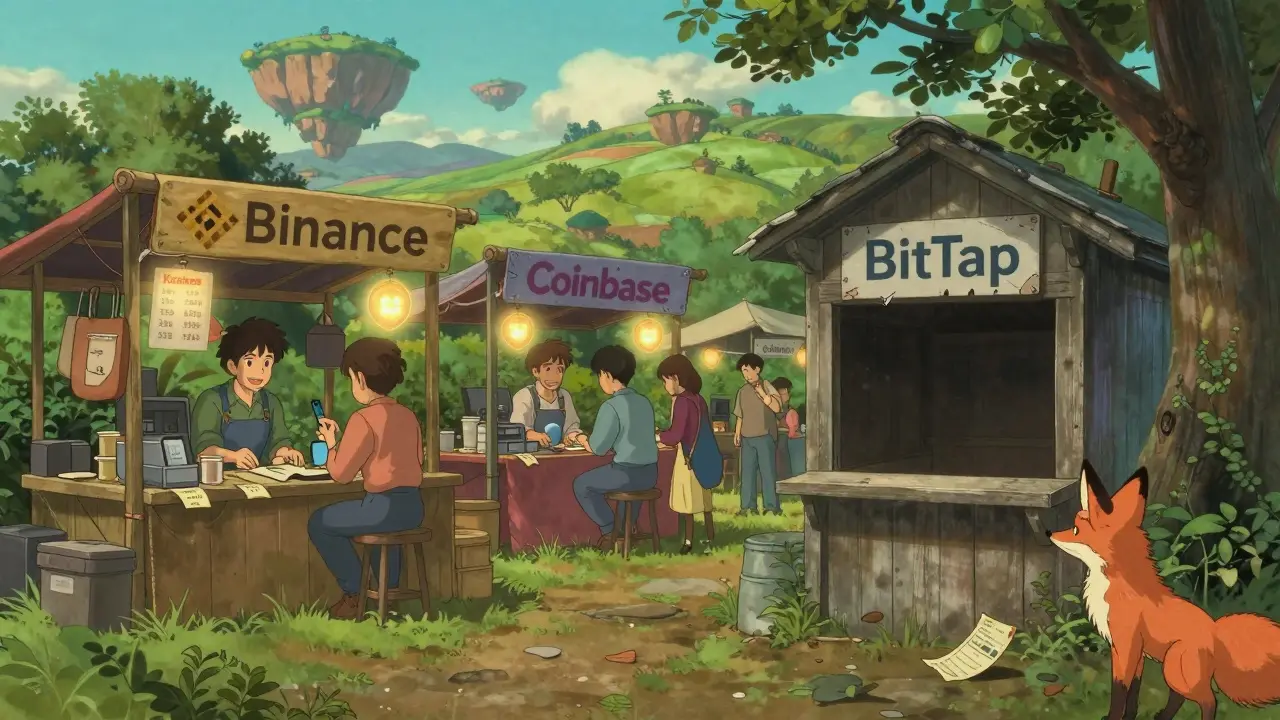
BitTap claims to be a fast, liquid crypto exchange for trading Bitcoin, Ethereum, and Solana. But if you’re thinking about depositing money there, you need to know what’s missing-and what’s not being said. Unlike big names like Binance or Coinbase, BitTap doesn’t publish its trading volume, user count, or regulatory status. No third-party audits. No clear fee schedule. No user reviews on Trustpilot or Reddit. That’s not just quiet-it’s risky.
What BitTap Actually Offers
BitTap’s website says it supports spot trading, futures, and margin trading. That sounds impressive, but what does it mean in practice? Spot trading lets you buy or sell crypto right away. Futures let you bet on price movements without owning the asset. Margin trading lets you borrow funds to amplify your position-think of it like a leveraged bet. All three are available on BitTap, but here’s the catch: you can’t verify how deep the order books are. Liquidity matters. If a platform claims high liquidity but has no public trade history, you’re trusting a black box.
The platform works through a web interface and mobile apps. Downloads are available directly from their site, bittap.com. That’s standard. But most reputable exchanges also publish their app store ratings, update logs, and security certifications. BitTap doesn’t. No mention of two-factor authentication requirements. No details on cold storage usage. No history of security breaches or audits. That’s not normal for a platform handling real money.
What’s Missing: The Red Flags
Let’s talk about what you can’t find anywhere on BitTap’s site:
- Regulatory status: Is it registered with the FCA in the UK? The SEC in the US? Any authority? Nothing is listed. In the UK, all crypto exchanges must register with the Financial Conduct Authority since January 2021. If BitTap operates without this, it’s illegal for UK users.
- Fees: No clear fee structure. How much do you pay to deposit? Withdraw? Trade? Are taker and maker fees the same? No answer. Compare that to Binance, which lists fees down to the 0.01% level.
- Security: No mention of cold storage, insurance, or multi-sig wallets. Most exchanges lock 90%+ of assets offline. BitTap says nothing. That’s a red flag.
- User base: Binance has over 270 million users. Kraken, Coinbase, and KuCoin each have tens of millions. BitTap? Zero public data. If it were a major player, someone would have leaked numbers by now.
- Customer support: It says support is available, but there’s no email, no ticket system, no live chat timestamp. No response time estimates. No history of how they handled past issues.
And here’s the twist: there’s another site called bittap.org-a completely different project. It calls itself a non-custodial wallet and decentralized marketplace for Bitcoin assets. It has nothing to do with the exchange. This naming confusion is intentional or sloppy? Either way, it makes due diligence harder.
How BitTap Compares to Real Exchanges
Let’s look at what established platforms do that BitTap doesn’t:
| Feature | BitTap | Binance / Coinbase / Kraken |
|---|---|---|
| Regulatory registration | Not disclosed | Registered in multiple jurisdictions (UK, US, EU) |
| Trading fees | Not published | Clear tiered structure (0.01%-0.1%) |
| Supported assets | Bitcoin, Ethereum, Solana (estimated) | 500+ cryptocurrencies |
| Security audits | None public | Regular third-party audits (e.g., CertiK, Hacken) |
| User reviews | None on Trustpilot, Reddit, or similar | Thousands of verified user reviews |
| Customer support | No contact details | 24/7 live chat, email, ticket systems |
Platforms like Coincheck in Japan offer tiny minimum trades (500 JPY ≈ $3) and even let you pay utility bills with Bitcoin. They add value beyond trading. BitTap offers none of that. It’s just a trading terminal with no ecosystem.
Why This Matters: The Real Risk
Crypto isn’t just about price swings. It’s about trust. When you deposit funds, you’re handing over control. If the exchange gets hacked, goes offline, or disappears, your money could vanish forever. That’s why transparency isn’t optional-it’s the only thing keeping users safe.
Look at what happened to Kraken. The SEC fined them $30 million in 2023 for offering unregistered staking services. Kraken didn’t hide. They settled, adjusted, and kept operating. That’s accountability. BitTap doesn’t even acknowledge regulators exist.
And in the UK? The FCA banned Binance from regulated activity in 2021. That’s how seriously they take this. If BitTap isn’t registered with them, it’s not legal for UK residents to use it. That’s not a technicality-it’s a legal trap.
Who Should Avoid BitTap
If you fall into any of these groups, don’t use BitTap:
- You live in the UK, EU, US, or any country with crypto regulations.
- You want to trade more than just BTC, ETH, or SOL.
- You care about knowing your fees upfront.
- You’ve ever lost money on a platform because of hidden rules or delays.
- You prefer platforms with real user feedback and history.
Even if BitTap turns out to be legitimate, the lack of transparency makes it impossible to verify. That’s not a platform-it’s a gamble.

What to Do Instead
If you want a real crypto exchange, here’s what to look for:
- Check if it’s registered with your country’s financial regulator (FCA, SEC, etc.)
- Look for published security audits from firms like CertiK or Hacken
- Find clear, detailed fee schedules on their website
- Search Reddit and Trustpilot for user experiences
- Use platforms with at least 5 million users and 5+ years of operation
Exchanges like Kraken, Binance, Coinbase, and KuCoin have proven track records. They’re not perfect, but they’re transparent. That’s the minimum standard.
Is BitTap a legitimate crypto exchange?
There’s no public evidence that BitTap is regulated or audited. No registration with the FCA, SEC, or any major authority. No user reviews, no fee schedule, no security details. Without these, legitimacy can’t be confirmed. Treat it as unverified until proven otherwise.
Can I trust BitTap with my crypto?
No-not based on current information. Reputable exchanges disclose how they store assets (cold storage), who audits them, and how they protect users. BitTap shares none of this. If your funds disappear, there’s no way to prove they were handled responsibly.
Is BitTap the same as Bittap.org?
No. BitTap (bittap.com) is a centralized exchange for trading BTC, ETH, and SOL. Bittap.org is a non-custodial wallet and decentralized marketplace for Bitcoin-based assets. They are completely separate projects with different technology, goals, and ownership. Confusing them could lead to mistakes.
Why doesn’t BitTap show its fees?
Lack of fee transparency is a major red flag. All serious exchanges list fees upfront because traders compare them. If BitTap hides fees, it could be charging hidden costs, slippage, or withdrawal penalties. Without knowing, you can’t calculate your true cost of trading.
What should I use instead of BitTap?
Use exchanges that are regulated and transparent: Kraken (for US/EU), Binance (for global, where allowed), or Coinbase (for beginners). All three publish fees, security audits, regulatory status, and user support details. They’ve been around for years and have millions of users. Start there.
Final Thought
Crypto is risky enough without adding unverified platforms into the mix. If a company won’t tell you how it protects your money, how it charges you, or who’s watching over it, then you’re not trading-you’re gambling. BitTap might be fine. But without proof, you’re making a decision based on hope, not facts. And in crypto, hope doesn’t pay the bills.










Write a comment
Your email address will be restricted to us