
Imagine you are part of a community that owns a shared ledger. One day, someone proposes changing the rules. Everyone agrees, updates their software, and moves forward together. That is a smooth transition. Now imagine a different scenario: half the community loves the new rule, while the other half hates it. They cannot agree. So, they split into two separate groups, each running their own version of the ledger. This is a blockchain fork.
Forks are not bugs; they are features of decentralized systems. Because there is no central boss to force changes, blockchains rely on consensus. When consensus breaks or evolves, the chain splits. Understanding the difference between planned forks and contentious forks is crucial for anyone holding crypto assets or building on these networks. It determines whether your tokens will upgrade seamlessly or if you might suddenly find yourself holding two different coins with vastly different values.
The Anatomy of a Blockchain Fork
To understand why forks happen, we need to look at how blockchains maintain agreement. A blockchain is a distributed database where every participant (node) follows a specific set of rules called consensus protocols. If one node decides to follow different rules, it creates a divergence in the history of transactions.
Planned Forks are coordinated upgrades agreed upon by the majority of the network participants before implementation. Think of them as scheduled maintenance or software updates for your phone. You know they are coming, you read the notes, and you tap 'update.' The goal is to improve the system without breaking it.
In contrast, Contentious Forks are unplanned splits caused by fundamental disagreements within the community regarding the protocol's direction. These are less like software updates and more like political revolutions. They occur when a significant portion of the community refuses to accept a proposed change, leading to a permanent division into two incompatible chains.
How Planned Forks Work
Planned forks are the engine of progress in mature blockchains. They allow networks to add features, fix security vulnerabilities, and improve efficiency without fracturing the community. The process is highly structured.
It usually starts with a proposal. In Ethereum’s case, this is an Ethereum Improvement Proposal (EIP). Developers draft the technical details, and the community debates them over months. Once a consensus is reached, core developers write the code. Miners, validators, and exchanges then coordinate to activate the change at a specific block height.
| Feature | Detail |
|---|---|
| Consensus Level | Near-universal (95%+ of nodes/miners) |
| Timeline | Months of planning and testing |
| Outcome | Single upgraded chain |
| Risk | Low (technical bugs possible, but social split unlikely) |
A prime example is Ethereum’s Berlin hard fork in April 2021. The community knew it was coming. Exchanges announced support weeks in advance. When the activation block arrived, 99.5% of the network upgraded within 24 hours. There was no drama, just a smoother, more efficient network. The token didn’t split; it just got better.

The Chaos of Contentious Forks
Contentious forks are messy. They happen when the community cannot reach an agreement on a critical issue, such as block size limits or response to a hack. Since blockchains are immutable, reversing a decision requires everyone to agree. If they don’t, the minority can choose to keep the old rules, creating a new chain.
The most famous example is the Bitcoin Cash fork in August 2017. The debate centered on scaling: should Bitcoin increase its block size to handle more transactions? One group said yes, arguing for faster payments. The other said no, arguing that larger blocks would centralize mining and hurt decentralization. The disagreement was irreconcilable.
On August 1, 2017, the network split. Bitcoin (BTC) continued with the original small blocks. Bitcoin Cash (BCH) launched with larger blocks. Suddenly, holders of BTC also held BCH. But the community fractured. Hash rate-the computational power securing the network-split roughly 55% to BTC and 45% to BCH initially. Over time, BTC retained the vast majority of value and development activity, while BCH struggled with further internal conflicts.
Hard Forks vs. Soft Forks: The Technical Distinction
When discussing forks, you will often hear the terms "hard" and "soft." This refers to compatibility, not necessarily contention. However, the type of fork influences how contentious a split might become.
Hard Forks are non-backward-compatible changes that create a permanent divergence from the previous version of the blockchain. Nodes that do not upgrade will reject the new blocks. This means all participants must upgrade to stay on the same chain. If some refuse, a split occurs. Both planned and contentious forks are typically hard forks.
Soft Forks are backward-compatible changes that tighten the consensus rules. Older nodes still see the new blocks as valid, even if they don't understand the new features. This makes soft forks easier to implement because they don't require 100% participation to avoid a split. Bitcoin’s Segregated Witness (SegWit) in 2017 was a soft fork. It activated successfully because it didn't force a chain split; non-upgraded nodes simply ignored the new witness data.
Why the Difference Matters for You
If you are an investor or a user, understanding these distinctions protects your portfolio and informs your strategy.
- Asset Duplication: During a contentious hard fork, you may receive tokens on the new chain. For example, after the Bitcoin Cash fork, BTC holders received BCH. After the Ethereum Classic fork in 2016, ETH holders received ETC. You need to check if your exchange supports the new asset. If you hold coins in a personal wallet, you likely have both, but you must secure them separately.
- Value Dilution: Planned forks generally preserve value because the community stays united. Contentious forks often lead to volatility. The new chain usually has a lower market cap and less liquidity. In the case of Bitcoin SV (a fork of Bitcoin Cash), the value dropped significantly compared to the parent chains due to lack of adoption.
- Security Risks: New chains created by contentious forks are vulnerable to replay attacks. This means a transaction made on one chain could be copied and executed on the other. Always use unique addresses for each chain after a fork to prevent accidental double-spending.
Governance and the Future of Forks
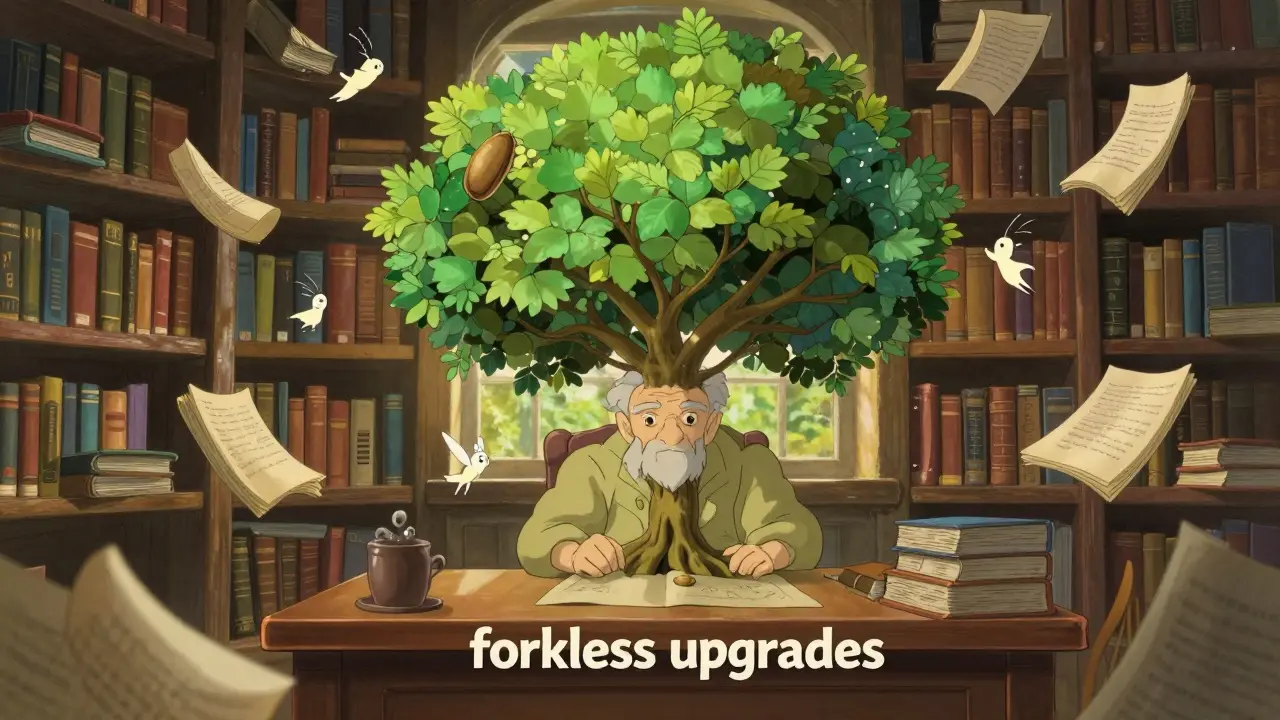
The frequency of contentious forks is declining. Why? Because governance mechanisms are maturing. Projects like Polkadot have introduced "forkless upgrades," allowing the network to update its runtime logic without splitting the chain. This is achieved through on-chain voting, where stakeholders approve changes directly.
Data from the Cambridge Centre for Alternative Finance shows that projects with formal governance frameworks experience 68% fewer contentious forks. As blockchain technology evolves, the hope is that planned, coordinated upgrades will become the norm, minimizing the disruptive potential of contentious splits.
However, the possibility of contention remains inherent to decentralization. As long as there is no central authority, there will be disagreements. The key is to recognize the signs: prolonged debate, polarized developer communities, and competing visions for the protocol’s future. When you see these red flags, prepare for a potential split.
What happens to my coins during a planned fork?
Nothing changes for your existing balance. Your coins remain on the same chain, which is now upgraded with new features. You do not receive new tokens, nor do you lose access to your funds. The upgrade is seamless if your wallet provider supports it.
Do I get free coins during a contentious fork?
Yes, typically. If you hold the original cryptocurrency in a private wallet at the time of the fork, you will also hold an equivalent amount on the new chain. However, exchanges may distribute these tokens differently, so check their announcements. Note that the new tokens may have little to no initial value.
Is a hard fork always bad?
No. Hard forks are necessary for major upgrades. Ethereum has undergone multiple planned hard forks (like Byzantium and Istanbul) that improved performance and security. The term "hard" refers to technical incompatibility, not social conflict. Only contentious hard forks are considered risky due to community fragmentation.
What is a replay attack?
A replay attack occurs when a transaction valid on one blockchain is copied and executed on another compatible chain. This can drain funds from your account on the new chain. To prevent this, never reuse addresses across forked chains and use wallets that support replay protection.
Can a contentious fork ever succeed?
Rarely. While the new chain exists, it often struggles with reduced hash rate, smaller developer communities, and lower market confidence. Bitcoin Cash and Ethereum Classic survive but operate in niche markets compared to their parent chains. Success depends on solving a unique problem that the original chain ignores.






Write a comment
Your email address will be restricted to us