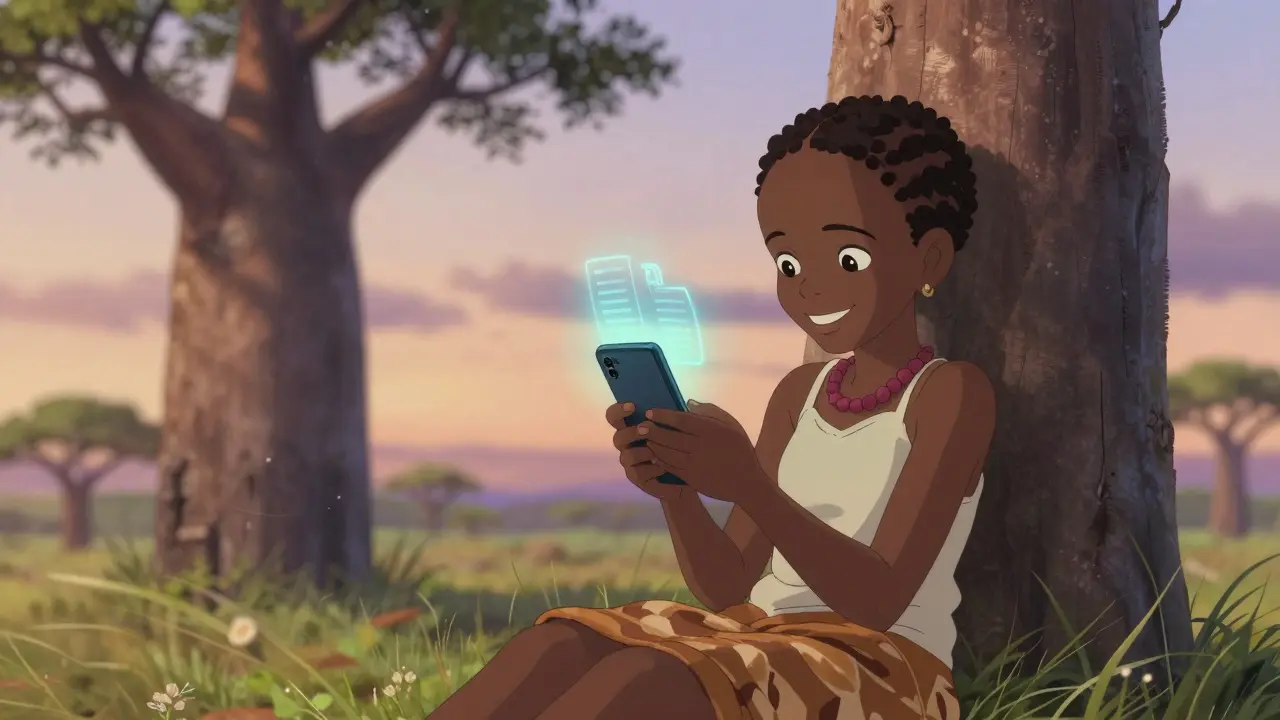
Over 1.7 billion people around the world don’t have a bank account. They can’t save money safely, get a loan, or pay for groceries without cash. In rural villages in Nigeria, informal markets in India, or remote islands in the Philippines, people live outside the formal financial system-not because they don’t want to, but because banks won’t serve them. Traditional banks need paperwork, physical branches, and credit histories. Most of these people have none of those things. But they do have cell phones. And that’s where blockchain steps in.
What Blockchain Actually Does for the Unbanked
Blockchain isn’t just about Bitcoin. At its core, it’s a digital ledger that records transactions without needing a central authority like a bank. This changes everything for people who’ve been locked out of finance. Instead of walking miles to a bank branch, someone in Kenya can send money to a family member in Uganda using a smartphone app. No middleman. No fees. No waiting. The magic happens through three key tools: digital wallets, smart contracts, and tokenization.- Digital wallets work like apps on your phone. You don’t need a bank to open one. Just download an app, create a key, and you’re in. No ID? No problem. Some wallets only require a phone number.
- Smart contracts are self-executing agreements coded onto the blockchain. Need a microloan? A smart contract can approve it automatically when you meet conditions-like sending daily payments via mobile money. No loan officer. No paperwork. No bias.
- Tokenization turns real-world assets-like land, crops, or even a small shop-into digital tokens. You can buy a fraction of a cow or a piece of farmland for $5. This lets people who can’t afford full ownership still build wealth over time.
This isn’t theory. In Kenya, M-Pesa already moved billions in mobile payments. Now, blockchain apps are building on that infrastructure. In Nigeria, startups are using blockchain to let farmers get paid instantly after harvest. In Mexico, women running small businesses are accessing credit through decentralized lending platforms-no collateral required.
How DeFi Removes the Middleman
Traditional finance is built on layers of institutions: banks, credit agencies, clearinghouses. Each adds cost, delay, and exclusion. Decentralized Finance (DeFi) cuts them all out. With DeFi, you lend directly to someone else. You borrow without a credit score. You earn interest on your savings-all through code running on public blockchains. No approval from a loan officer. No hidden fees. No minimum balance. Take Uniswap, for example. It started as a tool only coders used. Now, it’s a simple app anyone can use. You swap tokens with a few taps. No bank account needed. In places where banks charge 15% to send money abroad, DeFi apps charge less than 1%. That’s life-changing for migrant workers sending home remittances. A study by PwC found that blockchain-based systems could bring financial services to 1.4 billion people currently underserved. That’s not a guess. That’s based on real data from mobile usage, internet access, and existing digital payment trends.Real-World Examples That Are Already Working
Let’s look at three places where blockchain is making a real difference today.- Kenya: Over 90% of adults use mobile money. Now, blockchain-based apps like BitPesa let people convert mobile money into Bitcoin and send it internationally at a fraction of the cost of Western Union.
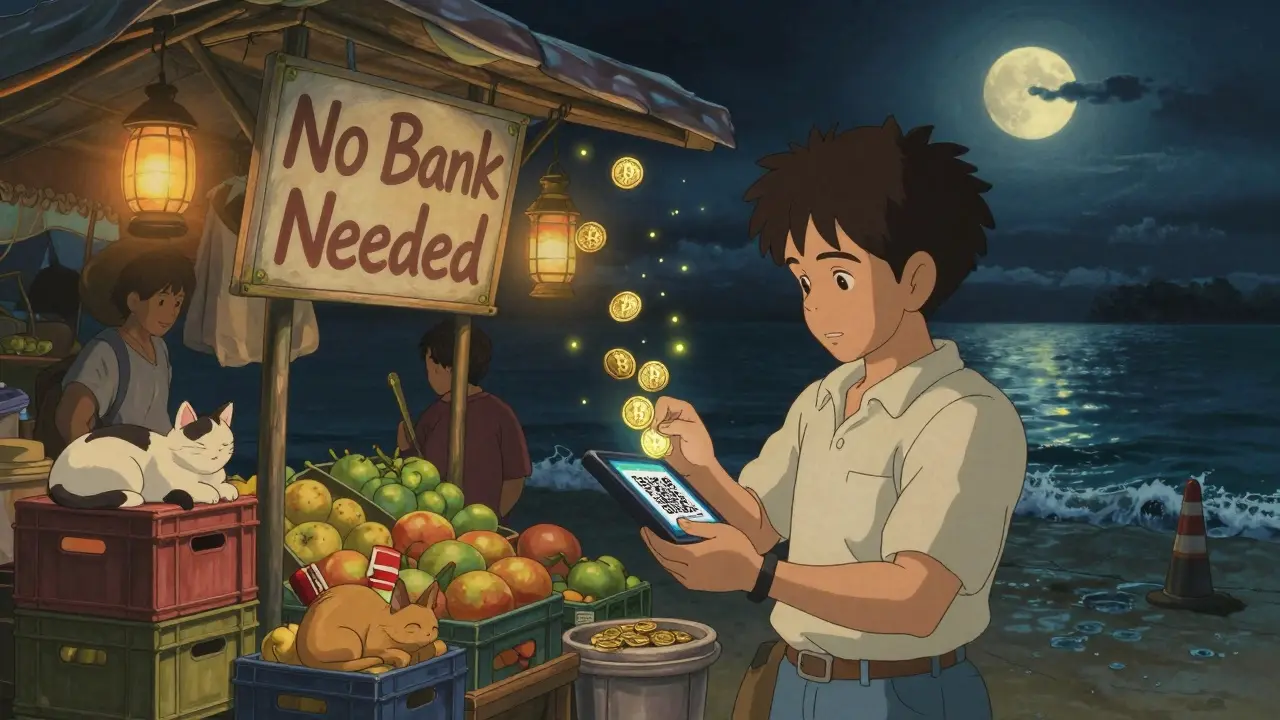
- Philippines: A startup called Coins.ph lets workers get paid in cryptocurrency, then cash out at local stores. No bank? No problem. They use QR codes and physical kiosks.
- India: In rural villages, Kiva and blockchain-powered platforms now let farmers get microloans based on their harvest history-recorded on a blockchain. No paperwork. No middleman. Approval in minutes.
These aren’t experiments. These are daily tools used by real people. One farmer in Tamil Nadu told a reporter: "I used to wait three weeks for my payment. Now, I get it the same day. I bought a new plow. My kids are in school again."
Why This Matters for Global Poverty
Financial inclusion isn’t about fancy tech. It’s about dignity. When you can save, borrow, or invest-even a little-you gain control over your life. You can plan for emergencies. You can start a business. You can send your kids to school. The World Bank calls access to a transaction account "the first step toward broader financial inclusion." Blockchain gives that access without needing a government-issued ID, a fixed address, or a credit history. In places where corruption is high or infrastructure is weak, blockchain’s transparency becomes a shield against fraud. Every transaction is recorded, permanent, and visible. A 2025 report from the Aspen Institute found that blockchain-based financial tools helped households in low-income regions increase their savings by an average of 40% in just 18 months. That’s not a fluke. It’s because people finally had access to tools that worked for them-not the other way around.The Challenges Nobody Talks About
Blockchain isn’t a magic fix. It’s a tool-and like any tool, it needs the right conditions to work.- Internet access: You can’t use a blockchain app if you don’t have data. In some rural areas, mobile networks are slow or unreliable.
- Regulation: Governments are still figuring out how to regulate crypto without crushing innovation. Some countries ban it. Others don’t know how to tax it.
- Education: Most people don’t understand private keys or seed phrases. If you lose them, you lose your money. No customer service line can help you.
- Scalability: Some blockchains are too slow or expensive for mass use. Newer ones, like Solana and Polygon, are fixing this-but adoption takes time.
And let’s not forget: blockchain alone won’t solve poverty. You need electricity, phones, education, and trust. But blockchain? It removes the biggest barrier: exclusion from the financial system.

The Future Is Already Here
Five years ago, blockchain finance was for techies. Now, it’s in the hands of street vendors, domestic workers, and smallholder farmers. Apps are getting simpler. Interfaces are getting friendlier. Costs are dropping. Look at Humaniq, a blockchain platform that lets people create digital identities using selfies and voiceprints. No ID card? No bank account? Just a face and a voice. Now they can access loans, insurance, and savings tools. In Ghana, over 120,000 people have signed up in two years. The shift isn’t about replacing banks. It’s about giving people options. For the first time, billions have a real chance to join the global economy-not as charity cases, but as participants.What Comes Next?
The next big leap? Integration. Blockchain isn’t replacing banks-it’s connecting to them. Mobile networks, government ID systems, and even utility payments are being linked to blockchain ledgers. Imagine paying your electricity bill with crypto and automatically earning rewards in digital tokens. Or getting a credit score based on your mobile payment history. Governments are starting to experiment. El Salvador made Bitcoin legal tender. Nigeria is testing a digital naira. India is piloting blockchain for rural credit. These aren’t just tech projects-they’re social infrastructure upgrades. The goal isn’t to make everyone a crypto trader. It’s to make sure no one is left behind because they were born in the wrong village, lack a passport, or don’t have a credit card. Blockchain won’t fix everything. But it’s the first technology in history that lets a person in a remote village have the same financial access as someone in New York. And that’s worth building.Can blockchain really help people without smartphones?
Yes, but indirectly. While most blockchain apps require a smartphone, solutions are being designed for feature phones. In India and Kenya, USSD codes and SMS-based systems let people interact with blockchain services without internet. For example, you can send money by texting a code to a number. The transaction is recorded on the blockchain, and the recipient gets a notification via SMS. This bridges the gap for people who can’t afford smartphones but still have basic mobile service.
Is blockchain more secure than traditional banking?
It depends. Blockchain’s ledger is tamper-proof-once a transaction is recorded, it can’t be changed. That’s more secure than paper records or centralized databases that can be hacked. But your personal wallet? If you lose your private key or fall for a phishing scam, there’s no customer service to reverse it. So while the system is more secure, users need to learn how to protect themselves. That’s why education is just as important as the technology.
Do I need to understand cryptocurrency to use blockchain for finance?
No. Many blockchain-based financial services now hide the crypto part entirely. You might be paying for groceries with a tokenized version of your local currency. Or saving money in a digital wallet that earns interest, without ever seeing Bitcoin or Ethereum. The technology works behind the scenes. You just need to know how to tap a button, scan a QR code, or send a text. The complexity is removed for the user.
Can blockchain help with credit for people with no credit history?
Absolutely. Traditional credit scores rely on bank statements and loan repayments. Most unbanked people have none. Blockchain changes that. Platforms now use alternative data: mobile top-ups, utility payments, even delivery receipts. If you consistently pay your phone bill on time via a blockchain app, that history becomes your credit score. In pilot programs in Indonesia and Colombia, this method approved loans for 72% of applicants who were previously denied by banks.
What’s stopping governments from adopting blockchain for financial inclusion?
Three things: control, fear, and cost. Governments are used to controlling money flow through banks and central systems. Blockchain gives power to individuals. That’s unsettling. There’s also fear of fraud, volatility, and loss of tax revenue. And while blockchain reduces long-term costs, setting it up requires upfront investment in tech and training. But countries like El Salvador and Nigeria are proving it’s possible-and profitable. The real question isn’t whether it works. It’s whether leaders are willing to let people have more control over their own money.




Write a comment
Your email address will be restricted to us