
When you're looking for a decentralized exchange that doesn't get rocked by front-running bots, VoltSwap sounds like a breath of fresh air. Built on the Meter blockchain, it promises fast trades, near-zero fees, and a system designed to keep traders safe from manipulation. But here's the reality: as of October 2025, VoltSwap's daily trading volume was just $6.02. That’s not a typo. For comparison, Uniswap moves over $1 billion daily. So is VoltSwap a hidden gem or a dead end? Let’s cut through the hype.
What Is VoltSwap, Really?
VoltSwap isn’t just another DEX. It’s the first front-running resistant cross-chain swap built on the Meter blockchain. That means if you’re trading assets across blockchains - say, swapping ETH for BTC without wrapping them - VoltSwap tries to make that smooth. It uses Meter Passport to handle the cross-chain part, so you don’t need third-party bridges. The whole thing runs on smart contracts, with no central server or company behind it. That’s good for security, bad for customer support.
The platform is entirely community-governed. No CEO. No corporate team. Just VOLT token holders voting on upgrades, fee structures, and new features. If you’re tired of centralized exchanges making unilateral decisions, this model has appeal. But it also means progress moves slowly. And if no one’s actively building or promoting it, the platform can stall.
The VOLT Token: More Than Just a Governance Tool
VOLT is the lifeblood of VoltSwap. With a max supply of 100 million tokens, about 53.87 million are currently circulating as of October 2025. The rest are locked up for future farming rewards over the next few years. That’s a deliberate design: 90% of all VOLT tokens were allocated to incentivize liquidity providers over four years.
Here’s the kicker: holding VOLT doesn’t just give you voting rights. It also earns you a cut of the exchange’s revenue. Unlike some DEXs that only reward liquidity pools, VoltSwap lets you stake VOLT alone - no need to pair it with another token. You get paid in MTRG (Meter’s native token), which you can then use to pay for gas fees or trade elsewhere.
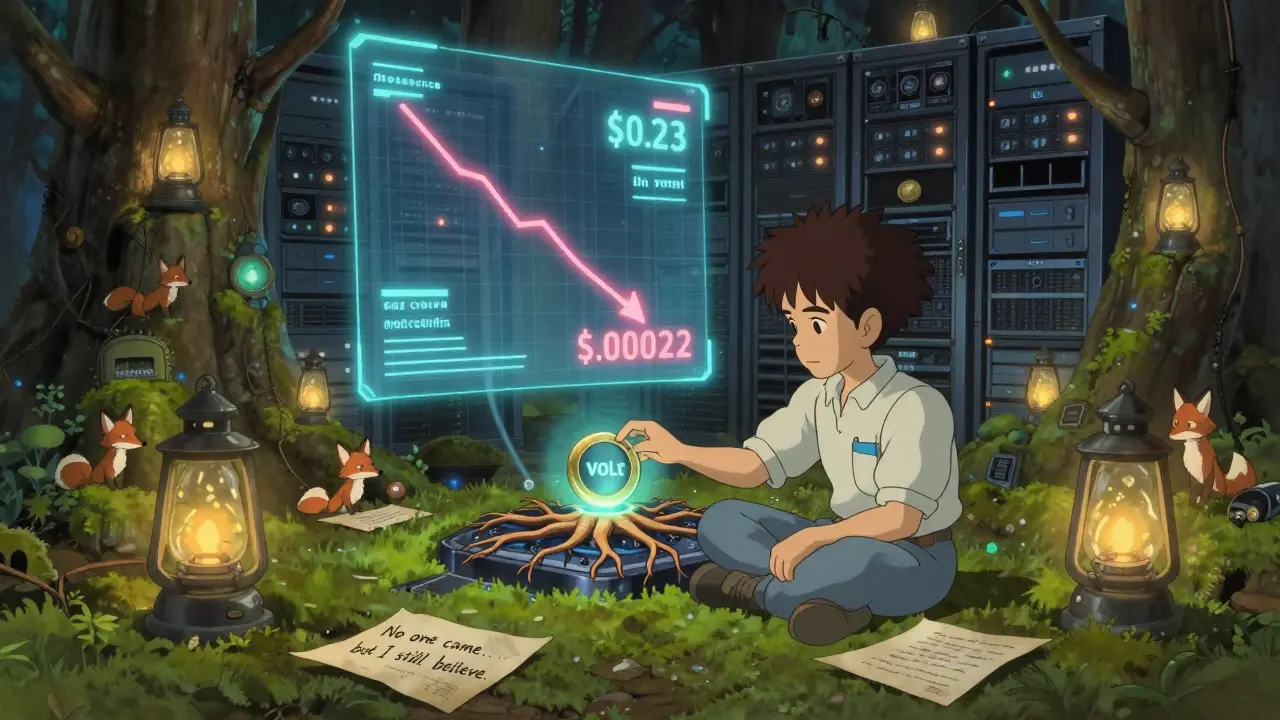
But let’s talk numbers. VOLT hit an all-time high of $0.2352 back in January 2022. Today, it trades around $0.00022. That’s a 99.9% drop. The all-time low? $0.0001521 in April 2025. So yes, it’s rebounded 58.7% from that floor, but we’re still talking about a token worth less than a penny. If you bought VOLT at its peak, you’d need a 1,000x gain just to break even. That’s not investing - that’s gambling.
Speed, Fees, and Front-Running Resistance
VoltSwap’s biggest technical win is its front-running protection. On most DEXs, bots watch the mempool and sneak in ahead of large trades, buying up the asset before you and selling it back at a higher price. It’s a silent tax on retail traders. VoltSwap claims to eliminate this by using Meter’s Layer 2 architecture. Transactions are batched and ordered in a way that prevents manipulation.
That’s powerful. But here’s the catch: it only works if everyone is on Meter. If you’re trying to trade from Ethereum or Solana, you’re stuck using Meter Passport - which adds complexity. And while transaction fees are low (paid in MTRG), you still need to hold MTRG to use the platform. No MTRG? No trades. That’s a barrier for newcomers.
Speed? Yes, it’s fast. Meter’s Layer 2 settles transactions in under 2 seconds. That’s faster than most Ethereum-based DEXs. But speed means nothing if there’s no liquidity. If you try to swap a small amount of VOLT for MTRG, you might get a 10% slippage because there are only a few hundred dollars in the pool. That’s not a bug - it’s the norm.
User Experience: Built for Devs, Not Beginners
The VoltSwap interface is clean. It’s not ugly. But it’s also not intuitive. There’s no tutorial. No onboarding flow. No help button. If you don’t already know how to connect a Web3 wallet (like MetaMask or WalletConnect), you’ll be lost. Even if you do, you’ll need to understand gas fees, token approvals, and cross-chain bridges.
There’s no mobile app. No customer service. No Discord community with active moderators. The only real support is the official GitHub and a Telegram group that’s mostly silent. If you make a mistake - like sending ETH to a VoltSwap contract by accident - there’s no way to recover it. That’s the nature of decentralization. But for most people, that’s a dealbreaker.
How VoltSwap Compares to Other DEXs
| Feature | VoltSwap | Uniswap (Ethereum) | PancakeSwap (BSC) | SushiSwap (Multi-chain) |
|---|---|---|---|---|
| Blockchain | Meter (Layer 2) | Ethereum | Binance Smart Chain | Multi-chain |
| Daily Volume | $6.02 | $1.2B | $480M | $210M |
| Front-running Protection | Yes | No | No | No |
| Tokenomics | Single-sided staking | Liquidity mining only | Liquidity mining only | Liquidity mining + staking |
| Token Price (VOLT/UNI/CAKE/SUSHI) | $0.00022 | $0.85 | $0.21 | $0.12 |
| Community Governance | Yes (VOLT holders) | Yes (UNI holders) | Yes (CAKE holders) | Yes (SUSHI holders) |
| Mobile App | No | Yes | Yes | Yes |
Look at the numbers. VoltSwap’s volume is less than 0.0005% of Uniswap’s. That’s not a small gap - it’s a chasm. Even if you love the tech, there’s no liquidity to trade meaningfully. And while front-running resistance is a real advantage, it doesn’t matter if no one’s using the platform.
Who Is VoltSwap For?
Three types of people might find value here:
- Early Meter adopters - If you believe in Meter blockchain as the future of scalable DeFi, VoltSwap is your main playground. You’re not here to get rich - you’re here to build.
- Yield farmers chasing high APY - With 90% of VOLT tokens still to be distributed, early stakers might earn decent rewards. But remember: low liquidity means your rewards could vanish if the price drops further.
- Researchers and hobbyists - If you’re studying how DEXs evolve without central control, VoltSwap is a living case study. It’s not a product - it’s an experiment.
Everyone else? Skip it. If you want to trade crypto, use Uniswap, PancakeSwap, or even a regulated centralized exchange like Kraken or Coinbase. You’ll get better prices, faster trades, and actual support if something goes wrong.

Regulatory Risks and Tax Implications
VoltSwap doesn’t ask for your ID. No KYC. No address verification. That sounds great - until tax season hits. In the UK, EU, US, and most other countries, every trade on VoltSwap is taxable. Whether you swap VOLT for MTRG or trade VOLT for ETH, you’ve triggered a capital gains event.
And here’s the problem: because VoltSwap doesn’t provide transaction records, you’re on your own. You’ll need to track every swap manually. Tools like Koinly or CoinTracker can help, but they’re not perfect. If you don’t report, you’re risking penalties. No one’s coming to get you - but the IRS and HMRC are watching blockchain data. They don’t care if it’s decentralized. They care if you profited.
The Verdict: A Tech Marvel, Not a Trading Platform
VoltSwap isn’t broken. It’s brilliant - on paper. The front-running resistance, single-sided staking, and Meter integration are real innovations. But innovation without adoption is noise.
The Meter blockchain hasn’t cracked mainstream. VoltSwap hasn’t built a critical mass of users. And without users, there’s no liquidity. Without liquidity, there’s no reason to trade. And without trading, the token’s value evaporates.
If you’re curious, try it with $5. Connect your wallet. Swap a tiny bit of MTRG for VOLT. See how the interface feels. But don’t invest money you can’t afford to lose. This isn’t a crypto gem - it’s a proof-of-concept with a long road ahead.
For now, VoltSwap is a niche tool for a niche audience. It’s not the future of DeFi. Not yet. Maybe someday. But not today.
Is VoltSwap safe to use?
VoltSwap is as safe as any decentralized exchange - meaning, it’s secure if you know what you’re doing. There’s no central server to hack, and the smart contracts are open-source. But there’s no safety net. If you send funds to the wrong address, lose your private key, or make a bad trade, there’s no customer support to fix it. Always test with small amounts first.
Can I buy VOLT on Coinbase or Binance?
No. VOLT is only listed on VoltSwap itself and a few tiny decentralized exchanges. You won’t find it on Coinbase, Binance, Kraken, or any major centralized platform. To buy VOLT, you need to connect your Web3 wallet to VoltSwap and trade MTRG or another supported asset directly on the platform.
Why is VoltSwap’s trading volume so low?
Because almost no one uses it. The Meter blockchain has far less adoption than Ethereum, Solana, or BSC. Without users, there’s no liquidity. Without liquidity, traders go elsewhere. It’s a classic chicken-and-egg problem. VoltSwap has the tech, but not the network.
Is staking VOLT worth it right now?
Only if you’re playing the long game. The APY looks high because the token price is so low. But if VOLT drops further, your staking rewards in MTRG won’t compensate for the loss in token value. Plus, with only $6 in daily volume, the revenue pool is tiny. You’re essentially betting that Meter will explode in popularity - and that’s a risky bet.
Does VoltSwap have a mobile app?
No. VoltSwap is only accessible via web browser using a Web3 wallet like MetaMask or WalletConnect. There’s no official iOS or Android app. If you want to trade on the go, you’ll need to use a browser on your phone - which is less convenient and more prone to errors.
What Comes Next?
If VoltSwap is going to survive, it needs three things: more users, more liquidity, and more integration. Right now, it’s stuck in a bubble. The Meter blockchain needs to attract developers. Developers need to build apps that use Meter. Those apps need users. And users need to trust that VoltSwap is the place to trade.
Until then, treat VoltSwap like a science project. Watch it. Learn from it. Maybe even experiment with a few dollars. But don’t count on it to make you money. The market has spoken - and right now, it’s saying VoltSwap is interesting, but not essential.







Write a comment
Your email address will be restricted to us