When you hear about Bitcoin being mined or Ethereum validators earning income, you’re really talking about block rewards. It’s the engine that keeps the whole system running. Without block rewards, no one would bother securing the network. No one would spend money on expensive hardware or lock up thousands of dollars in cryptocurrency just to help process transactions. Block rewards are the payment system of blockchain networks - and they work very differently depending on which coin you’re talking about.
What Exactly Is a Block Reward?
A block reward is what a miner or validator gets for successfully adding a new block to the blockchain. It’s not just a thank-you gift. It’s a financial incentive designed to keep the network secure, decentralized, and functioning. Every time a block is confirmed - whether it’s Bitcoin, Ethereum, or another chain - someone gets paid. That payment comes in two parts: newly created coins (called the block subsidy) and transaction fees from users.
In Bitcoin’s case, this system was built into the original whitepaper in 2009. Satoshi Nakamoto knew that if people had no reason to mine, the network would collapse. So he created a rule: every 10 minutes, roughly, a new block would be added, and the person who solved the math puzzle would get a fixed number of new bitcoins. That number wasn’t random. It was designed to shrink over time, ensuring Bitcoin would never flood the market.
How Bitcoin’s Block Reward Works
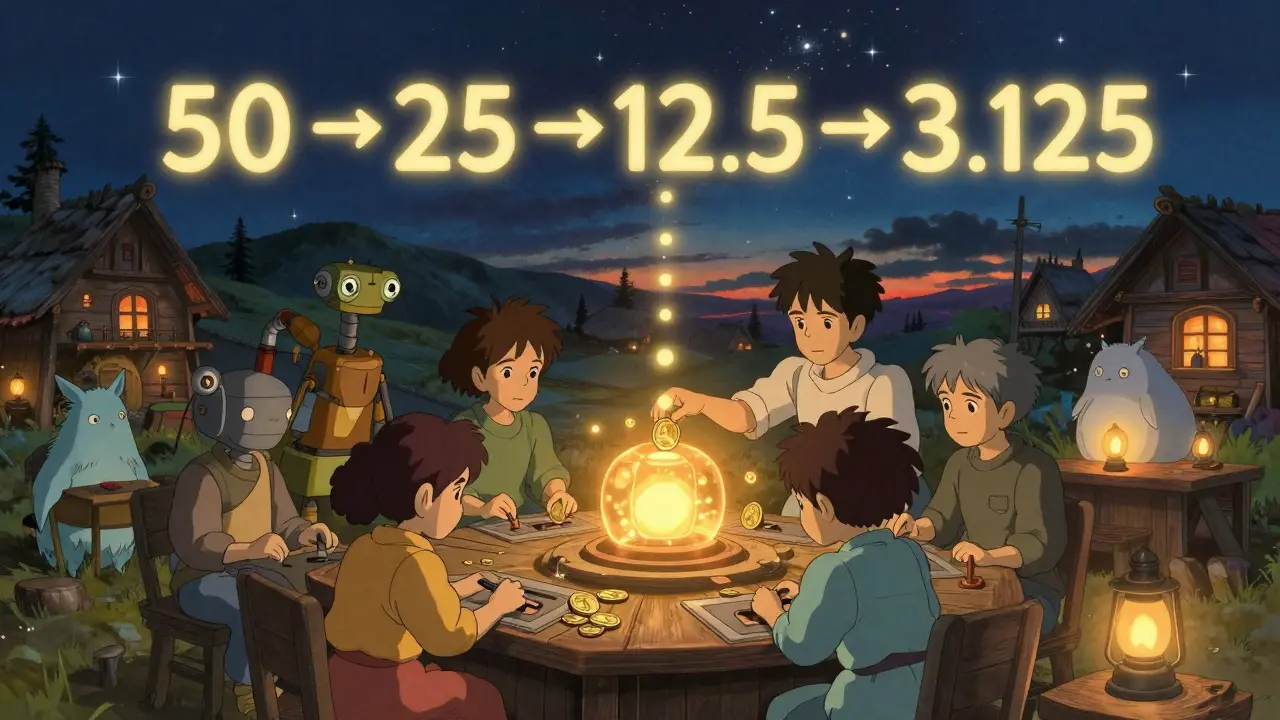
Bitcoin’s block reward started at 50 BTC per block in 2009. Every 210,000 blocks - about every four years - that number gets cut in half. This is called a halving. The last one happened on April 20, 2024, dropping the reward from 6.25 BTC to 3.125 BTC. The next halving is expected around August 2028, when it’ll drop to 1.5625 BTC. This continues until roughly the year 2140, when the last bitcoin is mined and the total supply hits 21 million.
Right now, block subsidy makes up about 98% of what Bitcoin miners earn. The rest - just 2% - comes from transaction fees. But that’s changing. As block rewards shrink, fees have to rise to keep miners motivated. If fees don’t increase enough, miners might leave, and the network could become less secure. Experts estimate that Bitcoin will need transaction fees of $50-$100 per block to match today’s security levels. That means users might pay $15-$25 per transaction on average, which sounds high today but could become normal as Bitcoin becomes more used for high-value transfers.
Ethereum’s Big Shift: From Mining to Staking
Ethereum used to work like Bitcoin - miners competed to solve puzzles and earned 2 ETH per block plus fees. But in September 2022, everything changed. Ethereum switched from proof-of-work to proof-of-stake in an event called The Merge. No more energy-hungry mining rigs. Instead, validators lock up 32 ETH (about $102,400 at $3,200 per ETH) to participate.
Validators don’t get a fixed reward anymore. Their earnings depend on how much ETH is staked across the whole network. The formula is simple: R = B × √(N), where B is a base factor (64) and N is total staked ETH. As more people stake, each validator earns less - but the network stays secure without flooding the market with new coins.
Post-Merge, Ethereum also changed how fees work. Thanks to EIP-1559, most transaction fees are burned (destroyed), not given to validators. Only the tip - the extra amount users pay to get their transaction processed faster - goes to validators. In early 2024, transaction fees made up 65-80% of validator income. This means Ethereum’s supply is actually shrinking when fees are high, making it potentially deflationary. That’s a huge contrast to Bitcoin’s predictable inflation.

Other Cryptocurrencies: Different Rules, Different Rewards
Not every blockchain follows Bitcoin or Ethereum’s model.
- Litecoin copied Bitcoin’s halving schedule but has a bigger supply cap (84 million coins) and faster blocks (every 2.5 minutes). That means it has a halving roughly every 4 years, just like Bitcoin - but more frequent payouts.
- Bitcoin Cash also uses halvings but with larger block sizes. Its reward structure hasn’t changed much since its 2017 fork.
- Monero avoids the “reward runs out” problem. After May 2022, it introduced a tail emission of 0.6 XMR per minute forever. This ensures miners always have an incentive, even if transaction fees stay low.
- Cardano uses a fixed inflation rate of 0.3% per year. Rewards are drawn from a treasury system, not just new coin creation.
- Solana starts with 8% annual inflation and gradually drops to 1.5% over 10 years. Validators earn rewards based on uptime and performance.
- Chia and Filecoin use proof-of-space and proof-of-storage, respectively. Their rewards are tied to how much disk space or data storage users contribute, not computing power.
These differences matter because they affect how secure, sustainable, and decentralized each network is long-term.
Why Block Rewards Matter for Security
Block rewards aren’t just about paying people - they’re about defense. The more money miners or validators make, the more they’re willing to spend on hardware, electricity, and security. This creates a natural barrier against attacks.
For example, if someone wanted to take over Bitcoin’s network (a 51% attack), they’d need to control more than half of all mining power. That would cost billions in hardware and electricity. The block reward makes that too expensive to be worth it.
But here’s the risk: as block subsidies shrink and fees don’t rise fast enough, that defense weakens. A 2023 IMF paper warned that Bitcoin’s security budget could drop by 99% once rewards disappear. If transaction volume doesn’t grow enough, the network could become vulnerable. That’s why experts are watching fee trends closely.
Who Earns Block Rewards Today?
In Bitcoin, solo mining is almost dead. It takes too much money and technical skill. Today, over 90% of Bitcoin mining happens through mining pools like F2Pool and Antpool. These pools combine the computing power of thousands of miners and split the reward based on contribution.
For Ethereum, the barrier is different. You need 32 ETH to become a validator. That’s a lot of money - but you can join a staking pool with as little as 0.1 ETH. Services like Lido and Coinbase let you pool your ETH and earn a share of rewards without running your own node.
Corporate mining is growing too. In 2024, 37% of Bitcoin blocks were mined by companies - up from just 12% in 2019. This raises concerns about centralization. If a few big players control most of the hash rate, they could influence the network.
The Economic Impact of Block Rewards
Block rewards are a massive economic force. In 2023, the global block reward market was worth $11.7 billion. Bitcoin alone accounted for $9.2 billion of that - nearly 80%. Mining consumes about 122 terawatt-hours of electricity a year - more than most countries. That’s directly tied to the reward amount. Higher rewards mean more mining, more power use.
Regulators are starting to take notice. The EU’s MiCA framework, effective in December 2024, treats block rewards as taxable income. The U.S. IRS has said the same since 2014: if you earn Bitcoin from mining, it’s ordinary income based on its value when you receive it.
What’s Next for Block Rewards?
The future of block rewards is about transition. Bitcoin must shift from subsidy-heavy to fee-heavy. Ethereum is already there. Other chains are experimenting with hybrid models.
Upgrades like Ethereum’s Prague hardfork (expected late 2024) will improve how validators earn from MEV (Maximal Extractable Value) - the profit from ordering transactions. This could boost validator income by 8-12% without increasing inflation.
But the big question remains: can transaction fees replace block subsidies without making crypto too expensive to use? If fees spike too high, everyday users get priced out. If they stay too low, the network risks becoming insecure.
Most experts agree: block rewards are the backbone of blockchain economics. They’ve kept Bitcoin alive for over 14 years. They’ve made Ethereum more efficient. And they’ll keep evolving - because as long as blockchains exist, someone has to get paid to keep them running.
Are block rewards the same for all cryptocurrencies?
No. Bitcoin uses halvings with a fixed subsidy that drops over time. Ethereum shifted to proof-of-stake and now pays variable rewards based on staked ETH and transaction tips. Litecoin follows Bitcoin’s model but with more frequent payouts. Monero uses a permanent tail emission. Each chain designs its reward system based on its goals - whether that’s scarcity, sustainability, or accessibility.
Do I have to mine to earn block rewards?
Not anymore. In Bitcoin, you still need mining hardware to earn block rewards directly. But for Ethereum and other proof-of-stake chains, you can stake your coins through a wallet or staking pool without owning a single piece of hardware. Many people now earn rewards just by holding and locking up their cryptocurrency.
Why does Bitcoin halve its block reward?
The halving is built into Bitcoin’s code to control supply. Satoshi Nakamoto wanted Bitcoin to mimic gold - scarce and hard to produce. By cutting rewards every four years, Bitcoin slowly reduces new coin issuance. This prevents inflation and gives early adopters more value over time. It also forces the network to rely more on transaction fees, which helps sustain security long-term.
Can block rewards run out?
For Bitcoin, yes - the subsidy will reach zero around 2140. But transaction fees will still pay miners. For Ethereum, no - it has no hard cap and keeps issuing new ETH at a low rate to reward validators. Monero will always pay a small tail emission. So it depends on the blockchain’s design. Some are built to end new issuance; others are designed to continue forever.
Are block rewards taxable?
Yes, in most countries. The IRS treats block rewards as ordinary income based on the coin’s value when you receive them. The EU’s MiCA rules, effective in 2024, also classify them as taxable events. Even if you don’t sell the coins, you owe taxes on the reward amount at the time it’s credited to your wallet.
Final Thoughts
Block rewards aren’t just a technical detail. They’re the heartbeat of cryptocurrency. They determine who gets paid, how secure the network is, and whether the system can survive for decades. Whether you’re a miner, a staker, or just someone holding Bitcoin, understanding block rewards helps you see why the system works - and what might break it.






Write a comment
Your email address will be restricted to us