
Imagine finding a cryptocurrency exchange with nearly 600,000 Twitter followers but zero website traffic. Sounds like a ghost town, right? That is exactly the situation with DOOAR (BSC), a decentralized exchange launched in 2022 that operates on the Binance Smart Chain network. It’s one of those platforms that looks impressive on social media metrics but falls apart when you look at the actual numbers. If you are considering trading here, you need to know what lies beneath the surface before you connect your wallet.
This review cuts through the noise. We will look at the real trading volumes, the limited liquidity, and the serious red flags that suggest this platform might not be worth your time or risk. By the end, you’ll understand why most traders stick to established giants like PancakeSwap or Uniswap instead of venturing into obscure corners of the BSC ecosystem.
The Reality of DOOAR's Trading Volume
Let’s start with the hard data. As of mid-2026, DOOAR reports a 24-hour trading volume of just $20,257.82. To put that in perspective, major exchanges process billions in daily volume. Even small-cap decentralized exchanges often handle millions. A drop of 12% in the last day alone signals shrinking interest rather than growing momentum.
Why does volume matter? It’s simple math. Low volume means fewer people are buying and selling. Fewer participants mean it’s harder to get your order filled at the price you want. You might click "buy" for $100 worth of tokens, but if there isn’t enough liquidity, you could end up paying significantly more due to slippage-the difference between the expected price and the executed price.
The platform only supports three coins and three trading pairs. That is incredibly restrictive. Most modern DEXs offer hundreds, if not thousands, of pairs. Being limited to these specific assets suggests DOOAR hasn’t evolved since its launch in 2022, leaving users with almost no flexibility.
Breaking Down the Three Trading Pairs
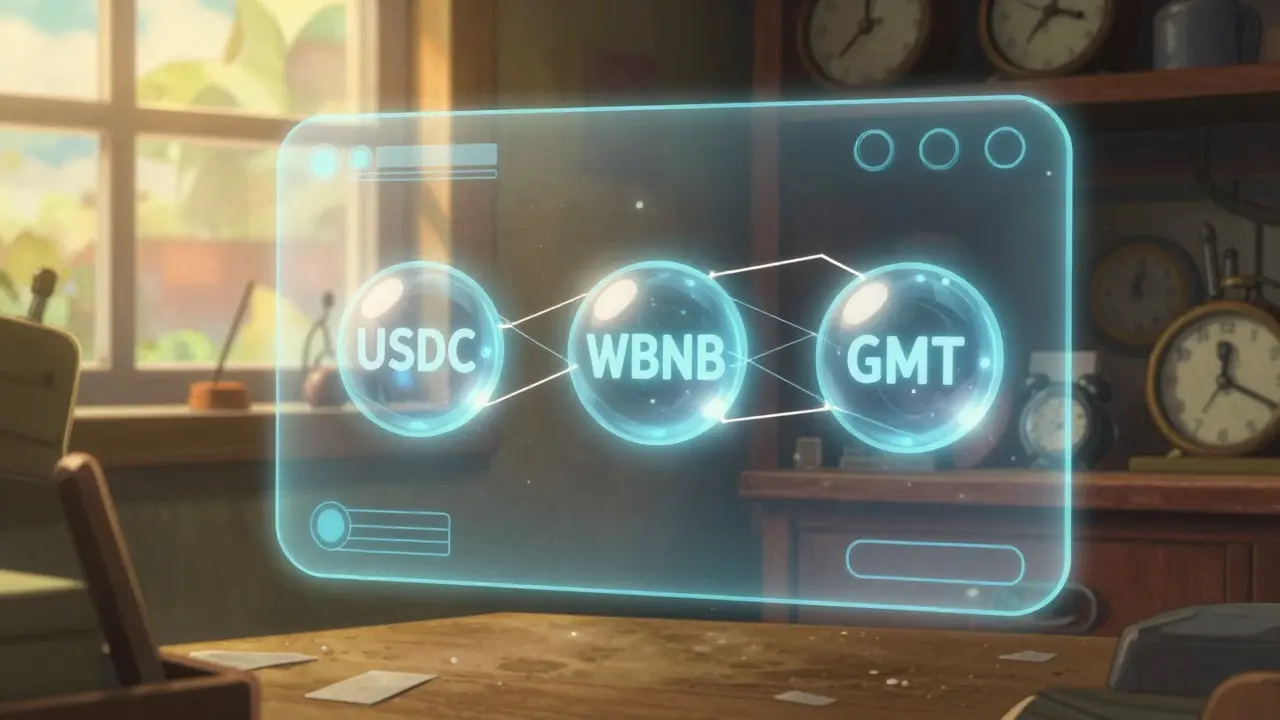
Since choice is limited, let’s look closely at what you can actually trade on DOOAR. The platform focuses entirely on stablecoin pairs against Wrapped BNB (WBNB) or other assets against USDC. Here is how the activity breaks down:
| Trading Pair | 24h Volume | Market Share | Bid-Ask Spread | Liquidity Depth (+2%) |
|---|---|---|---|---|
| USDC/WBNB | $13,287.72 | 65.57% | 0.60% | $14,226 |
| GMT/USDC | $5,549.00 | 27.38% | 0.61% | $3,312 |
| GST-BSC/USDC | $1,429.00 | 7.06% | 0.61% | $1,274 |
The USDC/WBNB pair dominates the platform. WBNB is simply BNB wrapped to be compatible with Ethereum-style contracts, allowing it to trade alongside ERC-20 tokens like USDC. While the spread of 0.6% seems competitive on paper, the liquidity depth tells a different story. With only about $14,000 available within a 2% price range, any trade larger than $1,000-$2,000 will likely suffer from significant slippage. You won’t get the price you see on the screen.
The second pair involves GMT (Green Metaverse Token) from the STEPN app, trading against USDC. Similarly, the third pair features GST (Green Satoshi Token), also from STEPN. These are niche gaming tokens. The fact that DOOAR relies heavily on these two specific assets suggests it may have been built as a specialized venue for STEPN ecosystem traders. However, with daily volumes under $6,000 combined for these pairs, the market is thin. Trying to move meaningful capital here would result in poor execution prices.
Understanding the Binance Smart Chain Infrastructure
DOOAR runs on the Binance Smart Chain (BNB Smart Chain), a blockchain network known for low transaction fees and fast block times. This is a double-edged sword. On one hand, BSC uses a Proof of Staked Authority (PoSA) consensus mechanism that delivers blocks every 3 seconds. Transaction fees usually stay under $0.10. This makes micro-trading affordable compared to Ethereum, where gas fees can spike above $10 during busy periods.
However, running on BSC doesn’t automatically make an exchange safe or efficient. The network itself is robust, processing millions of transactions daily with over a million active addresses. But DOOAR is just one small application on top of this infrastructure. Think of BSC as a highway system; just because the roads are good doesn’t mean every car driving on them is reliable. DOOAR benefits from BSC’s speed and low cost, but it suffers from its own lack of liquidity and user adoption.
The compatibility with EVM (Ethereum Virtual Machine) standards means developers could theoretically port apps easily. Yet, DOOAR hasn’t leveraged this potential. There are no new listings, no margin trading options, and no advanced features like limit orders or staking integrations mentioned in recent updates. It remains a basic swap interface, offering little advantage over more established competitors.
The Social Media Illusion vs. Real Engagement
Here is where things get suspicious. DOOAR claims a massive following of 594,443 on Twitter. In the crypto world, community size often correlates with trust and utility. But look closer: monthly pageviews are reported at zero. An Alexa ranking of #1,935,804 places the site in the bottom tier of global web traffic. How do you have half a million followers but nobody visiting the website?
This discrepancy is a major red flag. It suggests several possibilities:
- The followers are bots purchased to create an illusion of popularity.
- The project was abandoned after initial marketing hype, leaving dead accounts behind.
- The team focused solely on social metrics without building a functional product that retains users.
In contrast, legitimate DEXs like PancakeSwap or Uniswap have high traffic, active developer communities, and transparent governance. Their social media engagement reflects real usage. DOOAR’s stats look like a facade designed to attract inexperienced investors who equate follower counts with legitimacy.
Security Risks and Lack of Transparency
When evaluating any decentralized exchange, security is paramount. Unlike centralized exchanges, you don’t deposit funds into DOOAR’s custody. Instead, you interact directly with smart contracts. This reduces counterparty risk but introduces smart contract risk. If the code has bugs or backdoors, hackers can drain your funds instantly.
There is no public information regarding smart contract audits for DOOAR. Reputable projects undergo rigorous testing by firms like CertiK, Hacken, or SlowMist. These audits verify that the code behaves as intended and lacks vulnerabilities. The absence of such documentation for DOOAR is alarming. Without independent verification, you are trusting unknown developers with your assets.
Furthermore, there is no mention of insurance funds, bug bounties, or a clear governance structure. Who controls the protocol? Can they pause trading? Can they change fees unilaterally? These questions remain unanswered. In the aftermath of numerous DeFi hacks in 2022 and 2023, transparency became non-negotiable. DOOAR offers none of this. You are operating in the dark.

Comparing DOOAR to Established Alternatives
If you are looking to trade BSC-based tokens, why use DOOAR when better options exist? Let’s compare it briefly with industry leaders.
| Feature | DOOAR (BSC) | PancakeSwap | Uniswap (via Bridge) |
|---|---|---|---|
| Daily Volume | ~$20k | ~$500M+ | ~$1B+ (Cross-chain) |
| Liquidity Depth | Very Low | High | High |
| Audits | None Public | Multiple Regular Audits | Extensive Audits |
| User Base | Negligible Traffic | Millions of Users | Millions of Users |
| Token Selection | 3 Pairs | Thousands of Pairs | Thousands of Pairs |
PancakeSwap, the native DEX of BSC, offers vastly superior liquidity, a wider selection of tokens, and proven security track records. Even if you prefer Ethereum-based assets, bridging to Uniswap provides deeper markets and higher trust. Using DOOAR exposes you to unnecessary risk for minimal benefit. The only scenario where DOOAR might make sense is if you specifically need to trade GST or GMT against USDC and cannot find another venue-but even then, the slippage costs likely outweigh any convenience.
Final Verdict: Avoid Unless Necessary
DOOAR (BSC) appears to be a stagnant project from 2022 that has failed to gain traction. Its tiny trading volume, shallow liquidity, and complete lack of web traffic contradict its inflated social media presence. The absence of security audits and transparent governance adds unacceptable risk. For any trader, especially beginners, sticking to well-audited, high-volume platforms is essential. DOOAR does not meet these criteria. Save your capital and your peace of mind by choosing exchanges with proven reliability and active communities.
Is DOOAR (BSC) a scam?
While there is no definitive proof of malicious intent, DOOAR exhibits many characteristics associated with abandoned or low-effort projects. The combination of zero website traffic, no security audits, and bot-like social media metrics raises serious concerns. It may not be a direct scam, but it is highly risky and likely unsustainable.
What tokens can I trade on DOOAR?
Currently, DOOAR only supports three trading pairs: USDC/WBNB, GMT/USDC, and GST-BSC/USDC. These involve Wrapped BNB, USD Coin, Green Metaverse Token, and Green Satoshi Token. No other assets are listed.
How much does it cost to trade on DOOAR?
Transaction fees depend on the Binance Smart Chain network, typically costing less than $0.10 per trade. However, the hidden cost is slippage. Due to low liquidity, large trades will execute at worse prices, effectively increasing your total cost significantly.
Why does DOOAR have so few users?
DOOAR lacks competitive advantages. It offers fewer tokens, lower liquidity, and no unique features compared to established DEXs like PancakeSwap. Without incentives or superior technology, users naturally migrate to platforms with better depth and security.
Can I trust the smart contracts on DOOAR?
Trust should not be assumed. There are no publicly available audit reports from reputable security firms. Interacting with unaudited smart contracts carries a high risk of exploitation. Always prioritize platforms with verified security histories.






Write a comment
Your email address will be restricted to us