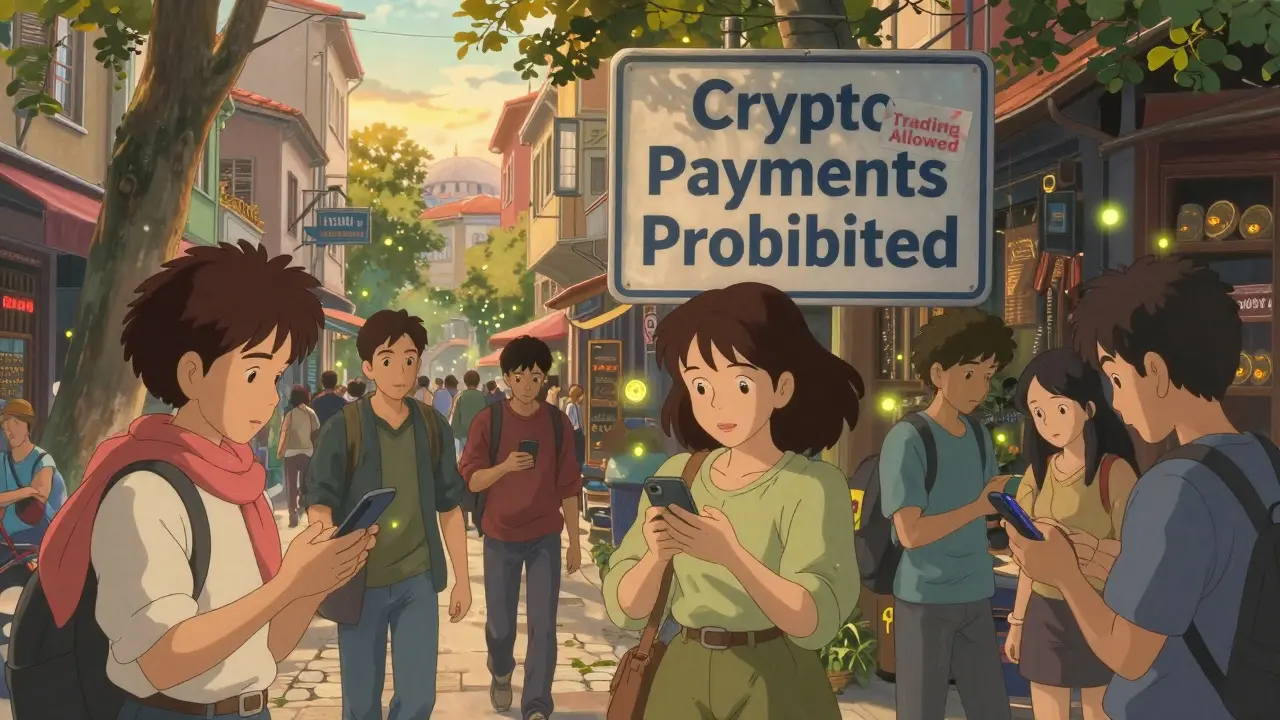
They can't use crypto to pay for coffee, but they trade billions anyway
In April 2021, Turkey banned using cryptocurrency for payments. The Central Bank said it was to protect people from wild price swings and fraud. But here’s the twist: buying, selling, and holding crypto? Still completely legal. And since then, Turkish citizens have turned the ban into a loophole they exploit daily. They’re not ignoring the rules-they’re outsmarting them.
By 2024, nearly 20 million Turks-almost half the adult population-owned crypto. That’s more than the entire population of Sweden. In just one year (July 2022 to June 2023), they moved $70.4 billion in crypto transactions. In 2024, that number jumped to $85.3 billion. This isn’t a fringe activity. It’s a national response to economic pressure, inflation, and a currency that keeps losing value.
How the ban actually works (and why it doesn’t stop trading)
The ban targets one thing: using Bitcoin, Ethereum, or other crypto to buy goods or services. You can’t pay your electric bill with Bitcoin. You can’t use it at a supermarket. But you can trade it on an exchange. You can send it to a friend. You can convert it to Turkish lira and then use that lira to buy coffee.
The government didn’t ban trading. They banned spending. That’s the gap people filled. If you can’t use crypto as money, you treat it like stocks or gold. Buy low, sell high. Hedge against inflation. That’s exactly what millions are doing.
And here’s the kicker: the Central Bank can’t stop people from trading. They can regulate exchanges, but they can’t stop someone from connecting to a foreign server or meeting a stranger in a Telegram group to swap crypto for cash.
The three main ways Turks trade crypto today
1. Licensed Exchanges (The Safe Path)
Platforms like Paribu, Binance Turkey, and Bitlo are officially approved by Turkey’s Capital Markets Board (CMB). You need to verify your identity-upload your ID, take a selfie, wait 15 to 45 minutes. Once you’re in, you can buy crypto with Turkish lira. Fees are low: 0.05% to 0.25%. Withdrawals to your bank account happen in under two hours.
But there’s a catch. Since February 2025, any transaction over 15,000 Turkish lira (about $425) triggers extra scrutiny. The system flags it. You might get asked for proof of income. Your account could be frozen if they think it’s suspicious. So what do people do? They split their trades. Buy 14,000 TL today. Buy another 14,000 TL next week. Use different family members’ accounts. It’s common. A March 2025 survey found 62% of users deliberately stay under the limit to avoid hassle.
2. Peer-to-Peer (P2P) Trading (The Wild West)
LocalBitcoins, Telegram groups, and WhatsApp circles have exploded. No ID needed. No bank links. You find someone who wants to sell Bitcoin for cash, meet at a coffee shop, swap money for crypto. Or do it remotely-send bank transfer, get wallet address.
It’s riskier. Scams happen. But the rewards are bigger. Premiums on P2P trades range from 0.5% to 2% above exchange rates. In a country where the lira lost 40% of its value in 2024, that’s worth it. LocalBitcoins saw a 217% surge in Turkish user activity from late 2021 to late 2024. By December 2024, Turkish P2P platforms were processing $1.2 billion in monthly trades.
3. DeFi and International Exchanges (The Tech Hack)
Most Turks can’t access Coinbase, Kraken, or Binance Global directly-their websites are blocked. So they use VPNs. A 2024 study by TÜBİTAK found 68% of crypto users in Turkey use a VPN to bypass these blocks.
Even more advanced users skip exchanges entirely. They use wallets like MetaMask or Trust Wallet. They connect to non-Turkish blockchain networks (RPC endpoints) and trade directly on decentralized exchanges like Uniswap or PancakeSwap. Even after PancakeSwap was officially banned in February 2025, users kept using it-just with a different server address. In Q1 2025, 3.7 million Turkish crypto addresses interacted with DeFi protocols. That’s not a glitch. That’s a movement.

Why the ban backfired
The government thought restricting payments would reduce crypto use. Instead, it made it more popular.
People saw the lira drop. Inflation hit 85% in 2023. Savings evaporated. Crypto became the only reliable store of value. The ban didn’t stop demand-it forced innovation.
Now, Turkey has a two-tier system:
- The compliant tier: Licensed exchanges. Regulated. Safe. Limited. Used by 35% of users but handling 58% of total volume.
- The shadow tier: P2P, VPNs, DeFi. Unregulated. Risky. Flexible. Used by 65% of users and handling 42% of volume.
It’s not chaos. It’s adaptation. The market figured out how to work around the rules faster than regulators could write them.
The hidden economy behind the trade
Behind every P2P trade, every VPN subscription, every custom wallet setup, there’s a small industry. TÜBİTAK estimates over 15,000 people in Turkey now work in crypto circumvention tech-building tools, running servers, writing tutorials, managing Telegram groups.
YouTube has over 1,200 Turkish-language crypto tutorials with 47 million total views. Telegram has 387 active crypto channels with 2.1 million subscribers. GitHub hosts open-source projects like “TurkWallet,” a tool that automatically splits transactions across wallets to stay under the 15,000 TL limit. It has over 4,200 stars and 87 contributors.
This isn’t just people trading crypto. It’s people building a parallel financial system.
Who’s doing it-and why
It’s not just tech bros. It’s teachers, shop owners, factory workers. The average crypto user in Turkey is between 25 and 44 years old. Sixty-seven percent fall into that group. Istanbul has 42% adoption. Rural areas? Only 18%.
Why? Because cities have better internet, more exposure to global trends, and more people feeling the squeeze of inflation. A shop owner in Ankara might buy USDT to protect her savings. A student in Izmir might trade Ethereum to pay for his semester abroad. A freelancer in Antalya might get paid in Bitcoin and convert it to lira slowly to avoid the 15k TL trigger.
Stablecoins like USDT make up 38.7% of all crypto transactions in Turkey. That’s not speculation. That’s survival. People aren’t trying to get rich overnight. They’re trying to keep what they have.

The risks are real
It’s not all smooth sailing. The Financial Crimes Investigation Board (MASAK) has frozen over 2,000 crypto accounts since 2022 for “suspicious activity.” Most were flagged because users exceeded transaction limits or moved large sums quickly.
Getting your account back can take 14 to 30 days. You need to submit documents. Prove your income. Explain why you bought $10,000 worth of crypto. Many give up. Others turn to P2P, where no one asks questions.
And then there’s the scam risk. Telegram groups are full of fake sellers. One user lost $8,000 in a single day after sending lira to a “trusted” trader who vanished. Community forums now have “scam alerts” pinned at the top of every subreddit and Telegram group.
What’s next? The government’s plan
In June 2025, the Capital Markets Board announced a new project: the “Crypto Asset Gateway.” By mid-2026, they want to force all crypto-to-lira conversions through a single, monitored system. Think of it like a toll booth for crypto.
The goal? To track every transaction. To control the flow. To eliminate the shadow market.
But experts aren’t convinced. Dr. Hasan Yılmaz from Istanbul Finance Center says: “As long as the payment ban stays and the lira keeps falling, people will find a way. The market adapts faster than the rules.”
Even the World Bank predicts Turkish crypto trading will hit $102 billion in 2025-up from $85 billion in 2024. The ban didn’t kill crypto. It made it more resilient.
What you need to know if you’re in Turkey
- If you want to trade safely: Use Paribu, Binance Turkey, or Bitlo. Do KYC. Stay under 15,000 TL per transaction.
- If you want flexibility: Use P2P on Telegram or LocalBitcoins. But never send money without verifying the seller.
- If you’re tech-savvy: Set up MetaMask with a non-Turkish RPC. Use a trusted VPN. Access global DEXs.
- If you’re worried about getting flagged: Split your trades. Use family accounts. Don’t move large sums all at once.
- If you’re new: Watch YouTube tutorials. Join one Turkish crypto Telegram group. Learn from others who’ve been there.
The truth? Turkey didn’t ban crypto. It banned convenience. And people responded by building something better.
Is it legal to trade crypto in Turkey?
Yes, buying, selling, and holding cryptocurrency is legal in Turkey. The 2021 ban only prohibits using crypto to pay for goods or services. Trading on exchanges, peer-to-peer, or via DeFi platforms is not illegal.
Can I use Binance or Coinbase in Turkey?
The global versions of Binance and Coinbase are blocked by Turkish internet providers. However, many users access them using a VPN. Binance also operates a licensed Turkish branch (Binance Turkey) that complies with local rules and accepts Turkish lira.
Why do Turkish people use stablecoins like USDT?
The Turkish lira has lost over 50% of its value since 2021 due to high inflation. Stablecoins like USDT are pegged to the U.S. dollar, so they act as a digital savings account. People buy USDT to protect their money and convert it back to lira when they need to spend.
What happens if I exceed the 15,000 TL transaction limit?
Exceeding the 15,000 TL threshold triggers mandatory reporting to MASAK, Turkey’s financial crimes unit. Your account may be frozen for review. You’ll need to provide proof of income or source of funds. Many users split transactions across multiple accounts to avoid this.
Are crypto scams common in Turkey?
Yes, especially on unregulated P2P platforms like Telegram groups. Scammers pose as sellers, take your lira, and disappear. Always use escrow services if available, verify identities, and never send money before receiving crypto. Community-run scam alerts are widely shared on forums.
How do people access decentralized exchanges like Uniswap?
Users connect wallets like MetaMask to non-Turkish blockchain nodes (RPC endpoints) instead of the default ones. They use a VPN to bypass website blocks. Once set up, they can trade tokens directly without an exchange. This method bypasses both the payment ban and exchange restrictions.







Write a comment
Your email address will be restricted to us