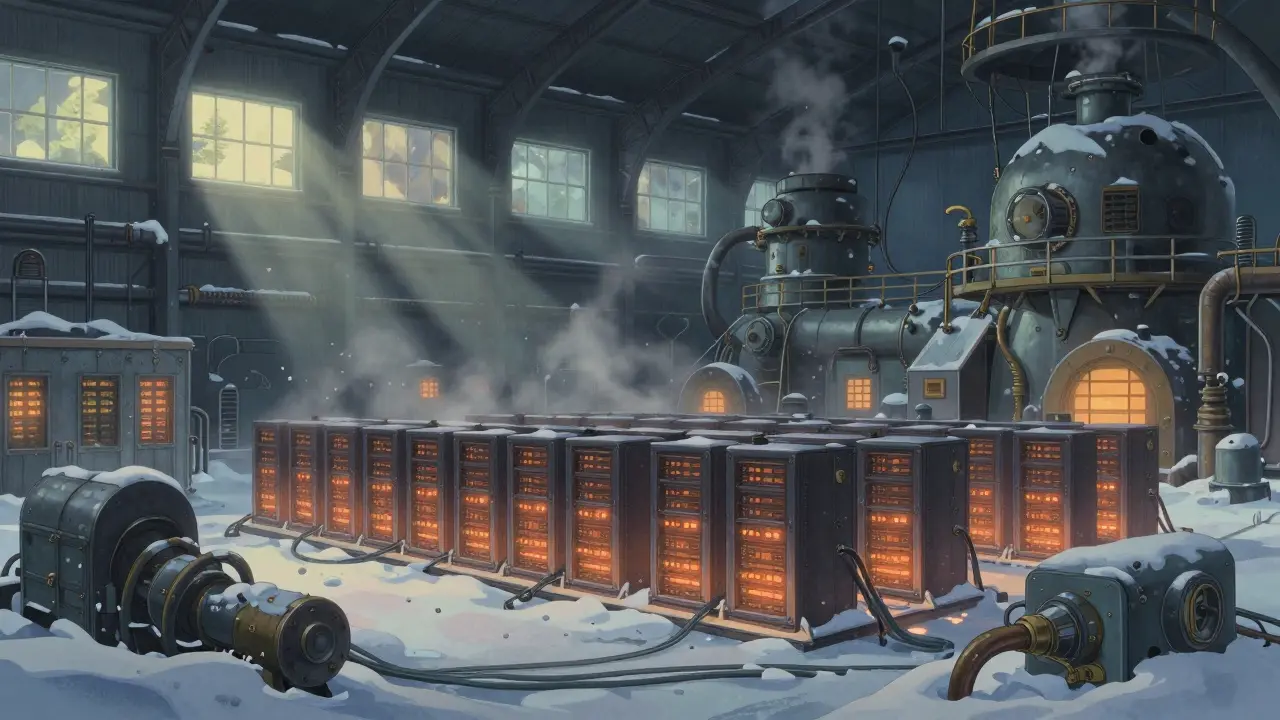
For years, the narrative around cryptocurrency in Russia was one of suspicion and restriction. Authorities treated digital assets with a wary eye, often banning banks from facilitating transactions or leaving regulations ambiguous. But that changed dramatically after February 2022. Facing unprecedented Western sanctions following the invasion of Ukraine, Moscow pivoted hard. The country didn't just tolerate crypto; it actively legalized and structured cryptocurrency mining as a strategic tool for economic survival and sanctions evasion.
This isn't about retail investors buying Bitcoin to hedge against inflation. It’s a state-backed effort to build an alternative financial infrastructure that operates entirely outside the traditional Western-controlled banking system. By legalizing mining and cross-border crypto payments, Russia aims to create a parallel economy capable of funding military operations and maintaining trade flows despite being cut off from SWIFT and major global currencies.
The Shift from Restriction to Strategic Embrace
To understand why this shift matters, you have to look at the timeline. Before 2022, Russia’s stance on crypto was largely prohibitive. The Central Bank frequently warned citizens about the risks, and commercial use was heavily restricted. However, the imposition of severe capital controls and asset freezes by the US, EU, and UK forced a rapid recalibration. The Kremlin realized that if conventional finance was blocked, digital finance had to be enabled.
Russia reportedly operates the world’s third-largest virtual currency mining industry. This existing capacity provided a ready-made foundation for expansion. By legalizing mining operations more formally, the state could direct electricity resources-often subsidized-to support hash rate growth while generating revenue through taxes or fees. More importantly, it allowed the creation of liquidity pools needed for larger, state-aligned transactions. The goal wasn’t decentralization in the ideological sense; it was sovereignty in the practical sense.
This move signals a broader commitment to developing alternative payment rails. If the dollar is off the table, what replaces it? For many sanctioned entities, the answer lies in cryptocurrencies and stablecoins that can be moved across borders without triggering alerts in traditional banking systems.
The A7A5 Stablecoin: The Engine of Shadow Trade
If there is a centerpiece to Russia’s new crypto strategy, it is the A7A5 stablecoin. Issued by Old Vector, a company based in Kyrgyzstan but backed by Russia’s state-owned Promsvyazbank (PSB), A7A5 was launched in February 2025 by pro-Russian oligarch Ilan Shor. Unlike Bitcoin, which fluctuates wildly, A7A5 is pegged to the Russian ruble, making it suitable for commercial trade.
The numbers are staggering. From its launch through July 2025, A7A5 facilitated over $51.17 billion in transactions. In its first four months alone, it processed an estimated $9.3 billion. What makes this particularly concerning for Western authorities is the pattern of usage. Blockchain analysis reveals clear business-day activity patterns, suggesting systematic use by commercial entities rather than speculative retail traders. These aren’t random transfers; they are likely payments for goods, services, or military procurement.
A7A5 was designed to be harder to monitor than conventional dollar-based stablecoins like USDT or USDC. Because it is tied to the ruble and traded primarily on platforms with Russian ties, it creates a closed loop that is difficult for external auditors to penetrate. Furthermore, the ability to purchase A7A5 tokens using PSB bank cards suggests an integration with the domestic banking system that bridges the gap between fiat and crypto.
| Feature | A7A5 Stablecoin | Bitcoin | USDT (Tether) |
|---|---|---|---|
| Currency Peg | Russian Ruble (RUB) | None (Market-driven) | US Dollar (USD) |
| Primary Use Case | Commercial/Military Procurement | Store of Value / Speculation | Global Remittances / Trade |
| Sanctions Risk | High (Targeted by OFAC) | Low (Decentralized) | Medium (Centralized issuer) |
| Volatility | Low (Stablecoin) | High | Low (Stablecoin) |
| Regulatory Oversight | Kyrgyz/Russian aligned | None | US/EU aligned |
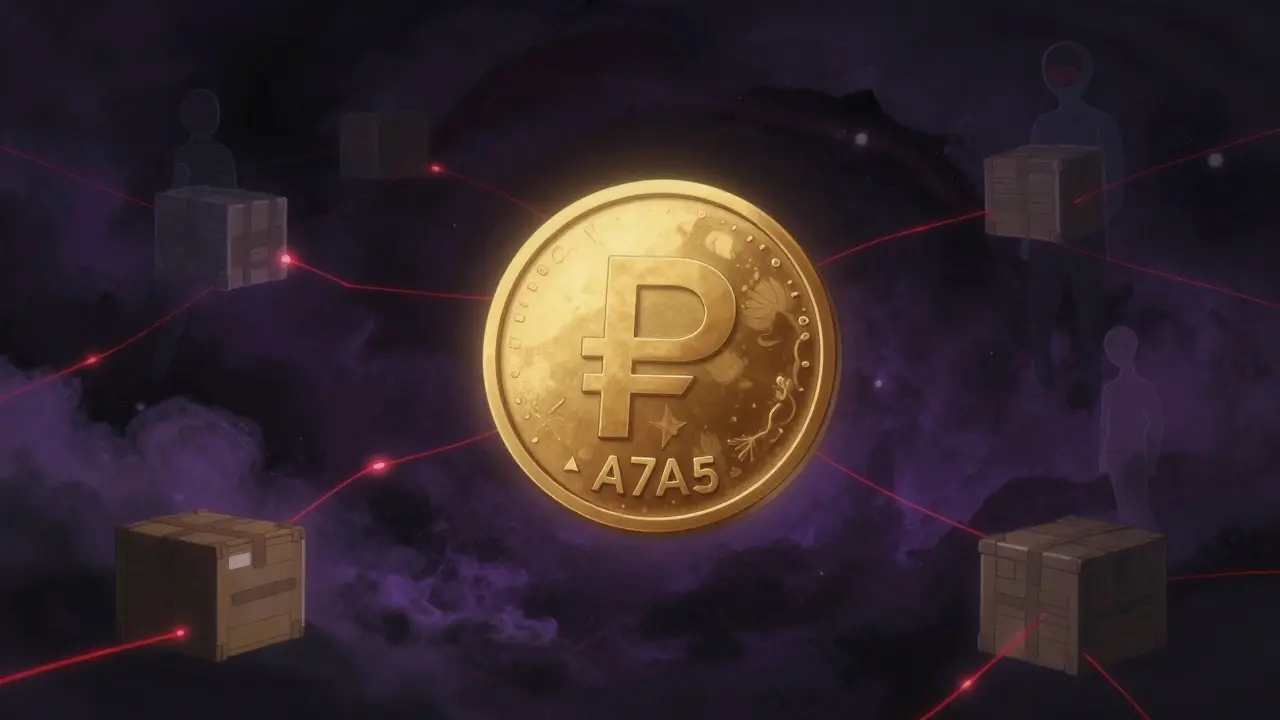
The Exchange Ecosystem: Garantex and Grinex
A stablecoin is only as useful as the exchanges that support it. Russia’s shadow crypto economy relies on a network of sanctioned exchanges and service providers. The most prominent example is Garantex, a crypto exchange with heavy Russian ties where A7A5 was largely traded. The US sanctioned Garantex in 2022, citing its role in laundering money for ransomware groups and facilitating sanctions evasion.
But when one door closes, another opens. In 2024, former employees of Garantex created Grinex. According to the US Treasury Department, Grinex was established specifically to bypass sanctions imposed on Garantex. Despite its origins, Grinex continued to facilitate large-scale transactions until the US sanctioned it in August 2025.
These exchanges operate on a "fairly small subset" of crypto platforms, many with notable ties to Russia. This insular ecosystem is designed to avoid Western oversight. By keeping trading volumes within a controlled circle of compliant or sanctioned entities, Russia minimizes the risk of exposure to mainstream, regulated exchanges like Binance or Coinbase, which adhere strictly to KYC (Know Your Customer) and AML (Anti-Money Laundering) laws.
The UK has also taken action, imposing sanctions on eight individuals and entities targeting the A7A5 infrastructure. This includes Luxembourg-based firms and four Kyrgyz entities linked to the stablecoin’s operations. The focus is not just on the software but on the human networks and financial intermediaries that keep the system running.
Western Countermeasures and Blockchain Transparency
You might think that cryptocurrency offers perfect anonymity. In reality, blockchain technology is highly transparent. Every transaction is recorded on a public ledger. While wallets don’t inherently reveal identities, the flow of funds is visible. This transparency is a double-edged sword. It allows for privacy, but it also allows for forensic analysis.
Blockchain analytics firm Chainalysis has documented Russia’s creation of what it terms a 'shadow crypto economy'. Chainalysis notes that entities within these networks have facilitated high volumes of transfers, providing crypto-to-crypto or ruble-to-crypto liquidity. However, the same transparency that enables these transactions also provides opportunities to identify and disrupt them.
On August 20, 2025, the US Treasury’s Office of Foreign Assets Control (OFAC) designated facilitators of Russian sanctions evasion. This marked the first time Treasury designated a virtual currency mining company. Under Secretary for Terrorism and Financial Intelligence Brian E. Nelson stated that "Treasury can and will target those who evade, attempt to evade, or aid the evasion of U.S. sanctions against Russia." This sends a clear message: mining operations that support sanctioned entities are fair game.
Simultaneously, the UK’s Office of Financial Sanctions Implementation (OFSI) sanctioned Grinex, Old Vector, and Meer. These actions target not only the crypto services themselves but also the operational infrastructure, including individuals linked to Kyrgyz banks used to pay for military goods. The coordinated response from both US and UK authorities demonstrates international cooperation in addressing crypto-enabled sanctions evasion.

Limitations of Crypto as a Sanctions Tool
Despite the sophisticated infrastructure, experts argue that cryptocurrency has significant limitations as a tool for sanctions evasion. The Bitcoin Policy Institute argues that Bitcoin is "ill-suited to help Russia evade sanctions" because it is "far too small to replace the dollar and the euro as a trade-currency."
Consider the scale. Russia’s annual pre-war exports totaled approximately $400 billion. At current market caps, this represents around 50% of Bitcoin's total value. Trying to conduct large-scale commodity trading through Bitcoin is impractical due to volatility concerns. A sudden drop in Bitcoin’s price could wipe out the value of a shipment of oil or gas mid-transaction. This is why stablecoins like A7A5 are preferred for commercial trade-they offer stability.
However, even stablecoins face hurdles. Liquidity remains a constraint. While A7A5 has seen billions in volume, it is still a niche market compared to the trillions flowing through traditional banking channels. Additionally, the reliance on specific jurisdictions like Kyrgyzstan creates geopolitical vulnerabilities. If pressure mounts on these partner nations, the entire infrastructure could crumble.
Academic research indicates that Russia is not alone in leveraging cryptocurrencies for sanctions evasion. North Korea and Venezuela have employed similar strategies. Yet, none have successfully replaced traditional finance entirely. Instead, crypto serves as a supplement-a way to squeeze through cracks in the sanctions regime, not break it down completely.
The Future of Russia’s Shadow Economy
The cat-and-mouse game between Russian evasion tactics and Western countermeasures is ongoing. As Russia continues to operationalize alternative payment rails through legalized crypto mining and stablecoin systems, the effectiveness of these tools remains constrained by market size limitations, regulatory countermeasures, and the inherent traceability of blockchain transactions.
We are likely to see further evolution in this space. Expect more localized stablecoins, deeper integration with non-Western banking systems, and potentially the use of privacy coins to obscure transaction trails. However, the fundamental challenge remains: without access to the global financial system, Russia’s economy faces structural bottlenecks that crypto alone cannot solve.
For now, the legalization of crypto mining in Russia stands as a testament to the adaptability of authoritarian states under pressure. It highlights how digital technologies can be repurposed for geopolitical ends, turning a decentralized innovation into a centralized instrument of state policy.
Why did Russia legalize cryptocurrency mining?
Russia legalized cryptocurrency mining to circumvent Western sanctions imposed after the 2022 invasion of Ukraine. By creating an alternative financial infrastructure, Russia aims to maintain trade flows and fund military operations outside the traditional Western-controlled banking system.
What is the A7A5 stablecoin?
A7A5 is a ruble-backed stablecoin issued by Old Vector, a Kyrgyzstan-based company backed by Russia's state-owned Promsvyazbank. Launched in February 2025, it has facilitated over $51 billion in transactions, serving as a key tool for commercial sanctions evasion.
How effective is Bitcoin for sanctions evasion?
Experts argue Bitcoin is ill-suited for large-scale sanctions evasion due to its volatility and limited market cap relative to Russia's export volume. Stablecoins like A7A5 are preferred for commercial trade because they offer price stability.
What role do exchanges like Garantex and Grinex play?
Garantex and Grinex are crypto exchanges with strong Russian ties that facilitate trading of sanctioned assets like A7A5. They operate in an insular ecosystem to avoid Western oversight, though both have faced US and UK sanctions for enabling evasion.
Can blockchain transparency help stop sanctions evasion?
Yes. While crypto offers pseudonymity, all transactions are recorded on public ledgers. Firms like Chainalysis use this data to trace fund flows, identify sanctioned entities, and provide evidence for regulatory actions by bodies like OFAC and OFSI.










Write a comment
Your email address will be restricted to us