
You’ve probably heard the horror stories. Validators losing their entire stake because they double-signed a block or went offline for too long. In the early days of Proof-of-Stake, these fears were well-founded. But if you look at the actual numbers today, the reality is surprisingly different. The data shows that malicious attacks are virtually non-existent, while operational errors account for nearly every single incident.
Understanding validator slashing statistics isn't just about satisfying curiosity; it’s about managing risk. Whether you’re running your own node or delegating to a service provider, knowing what actually triggers a penalty helps you make smarter decisions. Let’s break down the real numbers from major networks like Ethereum, Cosmos, and Polkadot to see where the danger really lies.
The Big Picture: How Rare Is Slashing Really?
When we talk about slashing, we mean the financial penalty imposed on validators who violate network rules. These rules exist to keep the blockchain secure and honest. If a validator tries to cheat or fails significantly in their duty, the protocol burns part or all of their staked assets.
Here is the striking fact: across all major Proof-of-Stake networks, the annual slashing rate is incredibly low. We are talking about fractions of a percent. For context, here is how the top networks compare based on data available through late 2024:
- Ethereum: Approximately 0.04% of active validators have been slashed since The Merge.
- Cosmos Hub: Roughly 0.07% of validators slashed between 2019 and 2023.
- Polkadot: About 0.03% of validators slashed in Q4 2023 reports.
- Solana: Estimated at around 0.05% annually (internal metrics).
These numbers tell us something important. Slashing works primarily as a deterrent. The threat of losing money keeps everyone honest. But because the actual incidence is so low, most new stakers overestimate the risk of being attacked by hackers and underestimate the risk of making a simple mistake themselves.
Ethereum Deep Dive: The Numbers Behind the Penalty
Ethereum has the largest number of validators, so its statistics carry the most weight. As of early 2024, there were roughly 916,000 active validators securing the network. Out of this massive group, only 414 incidents of slashing had occurred.
What caused these 414 incidents? According to ConsenSys, 99.7% of them were due to operational errors, specifically double-signing. This happens when a validator accidentally signs two different blocks for the same time slot. It’s usually not malice; it’s often a configuration error, a software bug, or a failure in hardware setup.
| Network | Approximate Active Validators | Total Slashed Incidents | Slashing Rate (%) | Primary Cause |
|---|---|---|---|---|
| Ethereum | ~916,000 | 414 | 0.04% | Double-signing (Operational) |
| Cosmos Hub | ~2,500 | ~18 | 0.07% | Downtime & Misbehavior |
| Polkadot | ~1,000 | ~3 | 0.03% | Protocol Violations |
| Solana | ~1,900 | ~1 | 0.05% | Unpublished/Internal |
The penalty structure on Ethereum is also nuanced. A minor offense might cost you 1 ETH. However, if many validators get slashed at the same time (suggesting a coordinated attack), the penalty scales up, potentially wiping out the entire 32 ETH stake. This variable penalty system is designed to make large-scale attacks economically unfeasible.
The Hidden Risk: Near-Misses and Operational Errors
If you only look at the official slashing counts, you might think the risk is zero. That’s misleading. Dr. Ari Juels from Cornell Tech points out that current statistics hide a bigger problem: near-misses.
Research analyzing 12,000 validator logs found that for every one actual slashing event, there are about 17 near-miss scenarios. In these cases, validators almost got slashed but managed to intervene manually or fix the issue just in time. Common causes include:
- Power outages causing nodes to go offline unexpectedly.
- Internet connectivity drops leading to missed attestations.
- Running duplicate validator clients on the same machine without proper safeguards.
This highlights why "operational security" is more important than "network security." You don’t need to worry about a hacker stealing your keys as much as you need to worry about your laptop crashing during a critical signing window.

How Network Design Affects Your Risk
Not all blockchains treat downtime the same way. Some networks are stricter than others, which directly impacts their slashing statistics.
Avalanche, for example, requires a 99.5% uptime. Ethereum is slightly more forgiving, expecting around 95% uptime before penalties kick in. Because of this stricter requirement, Avalanche sees 2.3 times higher slashing rates related to downtime compared to Ethereum. If you are considering staking on a specific chain, check its uptime requirements. Higher uptime demands mean higher technical complexity and potentially higher risk for solo validators.
Additionally, the size of the minimum stake matters. Networks with high entry barriers, like Ethereum’s 32 ETH requirement, tend to have fewer slashing incidents (47% fewer, according to Chainalysis) because professional operators dominate the space. Smaller networks with lower stakes often have more amateur participants, leading to slightly higher error rates.
The New Frontier: Restaking and Contagion Risks
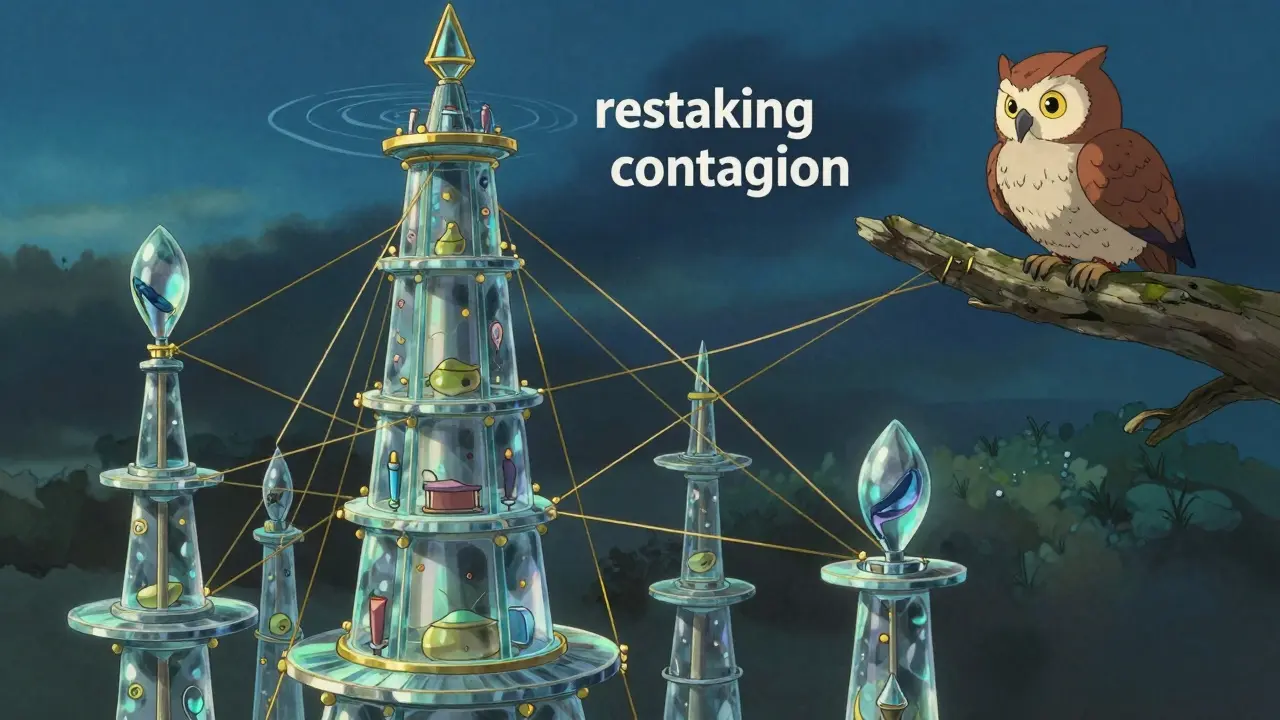
In 2023 and 2024, a new concept called restaking emerged, popularized by protocols like EigenLayer. Restaking allows validators to reuse their staked ETH to secure other services. While this increases capital efficiency, it introduces a new statistical risk: slashing contagion.
Imagine you stake ETH on Ethereum and then re-stake it to secure a bridge. If you make a mistake on the bridge, you could be slashed for both the Ethereum layer and the bridge layer simultaneously. A survey by Cubist found that 72% of professional validators view this "contagion" as their biggest fear. Currently, 41% of restaked value faces unquantified slashing risks because the rules for these new layers are still evolving.
This means that while traditional slashing stats remain low, the complexity of modern staking setups is rising. Solo validators need to be extra cautious about mixing standard staking with restaking protocols until the risk models are clearer.
Practical Steps to Avoid Being Slashed
Given that 99.7% of slashing events are operational errors, you can drastically reduce your risk by following a few best practices. You don’t need to be a cryptographer, but you do need to be organized.
- Use Slashing Protection Software: Tools like the Ethereum Foundation’s Slashing Protection Library have reduced double-signing incidents by 92% among users. Never run two instances of the same validator client without this protection.
- Diversify Your Hardware: Don’t rely on a single internet connection or power source. Professional validators use geographic distribution for backup nodes. At home, consider using a mobile hotspot as a failover.
- Monitor Uptime Closely: Set up alerts for when your node goes offline. If you miss attestations, you lose rewards first. Slashing comes later. Catching downtime early prevents it from escalating.
- Keep Software Updated: Client bugs are a common cause of accidental slashing. Follow the release notes of your chosen client (Prysm, Lighthouse, Teku, etc.) and update promptly.
- Understand the Specific Rules: Each network has different slashable conditions. Ethereum has seven distinct conditions. Cosmos has five. Read the documentation for the specific chain you are staking on.
What Do Experts Say?
Vitalik Buterin, co-founder of Ethereum, has stated that the low slashing rate proves the mechanism works as a deterrent. He argues that the system is effective precisely because people are afraid of it, even if they rarely experience it.
However, critics like Nic Carter warn that current statistics mask systemic risks. With staking power concentrated among a few large providers (like Lido or Coinbase), a single bug in their infrastructure could trigger a mass slashing event. The March 2023 Lido incident, where a technical error led to thousands of validators being affected, serves as a cautionary tale. Even though the final slashing count was low, the potential damage was enormous.
This concentration of power means that while individual risk is low, systemic risk remains. Diversifying where you delegate your stake, rather than putting everything into one large pool, is a smart strategy for retail investors.
What exactly is validator slashing?
Validator slashing is a penalty mechanism in Proof-of-Stake blockchains where a portion of a validator's staked cryptocurrency is destroyed (burned) or removed from their balance. This happens when the validator violates protocol rules, such as trying to sign conflicting blocks or failing to maintain required uptime.
Is it likely for a solo validator to get slashed on Ethereum?
It is statistically very unlikely. As of 2024, less than 0.04% of active validators on Ethereum have been slashed. Most incidents are caused by user error, such as running duplicate validator clients without proper protection software, rather than malicious attacks.
How much does it cost to get slashed?
On Ethereum, the penalty varies. Minor offenses can result in a loss of 1 ETH. More severe violations, especially those involving coordinated bad behavior, can result in the loss of the entire 32 ETH stake plus ejection from the validator set. Other networks may have fixed percentage penalties, ranging from 0.1% to 5% depending on the severity.
Does going offline always lead to slashing?
No. Short periods of downtime typically result in lost rewards (missed attestations) rather than slashing. Slashing for downtime usually occurs only after prolonged absence or specific protocol-defined thresholds are met, such as missing 150 consecutive blocks on some networks. However, frequent downtime increases the risk of hitting these thresholds.
What is the difference between slashing and deregistration?
Deregistration is the process of voluntarily leaving the validator set and withdrawing your stake. Slashing is an involuntary penalty where funds are destroyed as punishment for misbehavior. You can deregister at any time without penalty, provided you haven't already been slashed.
Next Steps for Stakers
If you are planning to start staking, focus on education before execution. Spend time understanding the specific rules of the network you choose. Use reputable tools for monitoring and protection. And remember, while the headlines scream about hacks, the data shows that careful, operational discipline is your best defense against losing money.
For those already staking, review your setup. Are you using slashing protection libraries? Do you have redundant internet connections? If not, now is the time to implement them. The statistics are on your side, but only if you respect the mechanics behind them.








Write a comment
Your email address will be restricted to us